Sunday, January 25, 2015

The Hunger Games and the rule of “Show, Don’t tell”

Welcome to my series on speculative fiction! For it, I will be focusing on three different series of books, highlighting three different lessons that readers (and writers) can learn from some of the best science fiction writers in the business. Since whole series are taken into account, I won’t be focusing much on plots, but rather on what unique lesson we can learn from each series as a whole. Also, beware of spoilers, and enjoy the second entry, The Hunger Games.

The Hunger Games

The Hunger Games

To begin with, a disclaimer: I love The Hunger Games. I’ve brought the books up frequently on this blog because I love them so much, especially the first. I love Katniss. I love Peeta. When I first read the series, I was just beginning to come out of a phase where I hardly read anything for pleasure. I’d been too swamped down by school reading and it had sucked the joy out of the written word for me for a time. The Hunger Games was an important part of breaking that cycle and for that, I will always love these books.

I say this because the point of this blog post is basically to give the third book of the series, Mockingjay, a whole lot of crap.

The thing is, whatever I accuse The Hunger Games of, I think Suzanne Collins and her books can take it. They’re good and they’re wildly successful. Nothing I say is going to hurt them, but possibly there are some good pieces of constructive criticism I can offer that might point to where the strengths and weaknesses of the series are, because they definitely speak to common issues that plague most writers and so a great deal of fiction.

To begin, the rule of “show, don’t tell.”

There are a few “writing rules” that get passed around in the community. Some have catchy little names like “murder your darlings.” Others are more to the point like “cut your adverbs.” Both of those rules apply during the editing stage of writing, and so you rarely think about them in a first draft. But if there’s one “rule” that is necessary to think about at every stage of the writing process, it’s “show, don’t tell.”

This “rule” is essentially a reminder that readers don’t want to be “told” something, but rather, “shown” it. What is meant by that? Let’s take the first novel in the Hunger Games series as an example. Katniss spends the first half of the book confused as to what Peeta’s motives are and why he is being kind towards her. Most of his kindness she misinterprets as somehow self interested – he’s only kind to Haymitch because he wants favoritism. He’s only kind to her to weaken her resolve. However, the reader is able to watch his actions and reinterpret them. By the time Katniss realizes his sincerity, Suzanne Collins has already given us pages and pages of compelling evidence that Peeta is kind and good and worth saving.

One of the reasons this is such a powerful example of “showing” rather than “telling” is because Collins is using the shown aspect of the story to undermine what is being said explicitly by her narrator, Katniss. Ultimately, the things that we are “shown” turn out to be truer than what was explicitly stated.

For another example, look at the way Collins describes the action in the first book. Every horror Katniss experiences, the reader follows along in step. She doesn’t say things like “I hallucinated because of the trackerjacker venom” but rather, we get to watch her hallucinations in real time. We watch her lose her hearing in her ear. We watch a fire ball explode onto her jacket. Over and over again, the reader is right next to her as horrible things happen to her.

And this is incredibly important to the story. Katniss is not a particularly “likable” person. She’s prickly and short tempered. She holds people at a distance. She’s bad at expressing feelings other than annoyance. But she is resilient. That resilience is incredibly compelling, and as a reader, we feel it every time she pulls herself through another horrific tragedy. Despite her sour disposition, it’s so hard not to empathize with her and root for her. Because haven’t we all felt that way? Put upon and beaten down, but determined to still keep going? It’s a situation we yearn to identify with, because at those moments, we are our best selves. And for all Katniss’s weaknesses, she is someone who keeps fighting no matter the cost.

But something unfortunate happens in the third and final book in the series, and I think it’s one of the biggest weaknesses the entire trilogy has. I’ve heard a lot of complaints about the final book. I’ll list a few potential problems:

1) The pacing felt so slow. It took forever for anything to actually happen.
2) The story felt kind of dark and pointless. Too many people died.
3) Katniss seemed like she’d just kind of given up. This isn’t the Katniss I loved.

These were all things I complained about too in one form or another, but I don’t think any of them is the problem. As I reread the book this past semester, I realized something. First, the pacing isn’t that bad. There actually is quite a lot going on in the book. It just doesn’t make an impact. Second, most of the deaths do make sense from a story telling perspective. They just don’t resonate. Third, Katniss is still fighting the capitol. She has her moments of doubt, but they aren’t that extreme, when you consider everything she’s going through. But for some reason, she just feels whiney.

In fact, all of these issues have the same root cause: Collins, who so excelled in showing rather than telling in the first book, forgot to SHOW us what everything was like any more.

Think again about the scene with the trackerjackers in the first book. The reader spends a long time with Katniss after the wasps sting her. She stumbles around, grabs arrows, sees a strange vision of Peeta, starts hallucinating out of control and, by the time she finally collapses, is convinced ants are digging through her eyes and she’s landed in a pile of bubbles. It is trippy as Pink Elephants on Parade. Similarly, when Rue dies, we watch her sing, decorate the body, pay tribute to District Eleven, go through the motions of staying alive and then snap in shock when she realizes she also killed Marvel that day.

Now let’s look at some transitions from the third book.

1) Katniss finds out District 12 has been bombed! Her reaction is – never mind, fade to black. We’ll start the third book a month later when she’s had time to process.
2) Katniss is terrible in front of the camera! We can tell because... because... because Collins says she is.
3) Peeta lunges at Katniss! Her reaction is – hey look! She’s waking up in the hospital a while later! We’ll talk about the strangulation with distance now.
4) Katniss is shot in Disctrict 2! Her reaction is – whoops, nope! We’re back at the hospital. Glad that’s over.
5) PRIM BLEW UP IN FRONT OF KATNISS! This must merit an intense reaction! This must mean – wait? We’re fading to black again? You mean we aren’t going to be with Katniss in the first minutes, then hours after Prim’s death?

Does this look at all like a pattern? In some books, this might not have been a problem. Some books thrive on emotional distance and making the horrific seem trivial by making it seem small. But that was never the angle of The Hunger Games. Our empathy for Katniss is largely derived by how real and immediate her danger feels. But over and over again in the third book, the audience is being kept out of her most traumatic moments.

Remember how in the first book, you wanted to cry for poor Katniss when they said she won the games, but at the sight of Peeta being taken away in a hovercraft she beat against the doors trying to get to him? Remember how she almost passed out from dehydration? For every emotional and physical trauma she suffered, we were there right with her.

The trauma is still there. Collins is still telling us that Katniss has been strangled and shot and devastated. But we’re not there with her through crucial points in those events. One or two “fade to black” moments wouldn’t have been so bad, but there are several. Any time the story got messy, Suzanne Collins backed us up out of the deep, immersed perspective of Katniss’s immediate reactions to her surroundings.

Now, you’ll notice that one of my observations was that the third book seemed dark, and my suggestions are, on some level, to actually make it darker. To show the pain. But I do think it would have helped, because it would have made it so the darker parts of the story didn’t seem needless. If we had been made to feel the pins Katniss walked on, we would have been glad to walk with her. We would have never told her she was complaining too much. We would have reached out to comfort her when her sister died. And at the end, when she finally finds the will to move past that grief, the relief would have been all the sweeter.

Again, I think the whole series is wonderful. There’s so much I could point to that Collins did well. And the ending is dark. I think perhaps she wanted to spare us from it. But ultimately, the honesty she showed before about Katniss’s pain was what we needed then. We needed to be there with her and feel the weight of just what she lost.

Thursday, January 15, 2015

The Giver Quartet and the Power of the Written Word

Welcome to my series on speculative fiction! For it, I will be focusing on three different series of books, highlighting three different lessons that readers (and writers) can learn from some of the best science fiction writers in the business. Since whole series are taken into account, I won’t be focusing much on plots, but rather on what unique lesson we can learn from each series as a whole. Also, beware of spoilers, and enjoy the first entry, The Giver.

The Giver

The Giver by Lois Lowry


When Lois Lowry first wrote the Newbery Award winning first book in her quartet, she meant for the book to stand alone. It has a complete arc, an ambiguous but satisfying ending, and a clear message. Subsequent books weren’t really needed in this case.

Or at least, that’s what I thought. Her fans didn’t so much agree.

First they clamoured for sequels that told them what happened to Jonas and Gabe, whom the ending of the first book left dying, but close to the homes of people who could save them. When I first read The Giver as a child, no one was really sure if they would live or if Jonas was maybe just dreaming of their rescue. My theory as a child had always been that the vision was real and Jonas did get them to the village, but that he died of exposure protecting Gabe.

 So Lois Lowry wrote Gathering Blue. And answered none of those questions. Touché, Lois. Touché.

The answers did come later – in Messenger and Son – but Lowry was clearly less interested in writing a series than she was in writing books. Each book in the series more or less stands on its own, following new characters in a new city, somewhere within the remains of the post-apocalyptic world Jonas grew up in. It’s only in Son that the reader finally returns to the old Community of Jonas’s youth and, luckily, the experience as a reader is once again horrifying.

If I had to identify Lowry’s two greatest strengths in her series, it would be those two things – that each book stands somewhat separate from the others, and that at their best, the strongest books in the series have this slow building sense of dread. And those two reasons are why The Giver was meant to be read more than seen.

For a book I’ve loved since childhood, I cannot tell you how not excited I was to hear about when it was finally adapted for film. The stories just don’t lend themselves to the razzle-dazzle, Katniss Everdeen style battle sequences and special effects we currently associate with YA dystopias. Jonas isn’t in a life or death situation. Death, in some sense, is an acceptable outcome for him, since his death would still force the memories he holds to revert back to the Community. It would have been a kind of noble sacrifice. So there are no life-or-death stakes in the book, no point in threatening his family and no emotions.

Let me repeat that. THERE ARE NO EMOTIONS. Well, there are some, but they’re vague approximations of the real things, or they’re new and fragile. They’re not grandiose. No one is threatening anyone. No one is falling in love. Turning this sort of story into a film would require a pretty restrained and sophisticated hand. I’m not saying it can’t be done, just that it would be incredibly hard and the current YA film market was not up to it.

On top of that, while yes, there is an ongoing series, it’s one that kind of eschews the whole notion of a franchise. There are four separate main characters. There are long time lapses between each book. By the end of the series, twelve-year-old Jonas has aged up to his mid-twenties, has kids and has kind of retired from the whole “saving the world” thing. If they wanted to keep Jonas as the focal point, there’s a lot of shifting around that would need to be done to the later books. He doesn’t even make another appearance until Messenger. And if they did do that, the movies would stop feeling like adaptations so much as full-on rewrites.

“But Emily!” you say, “surely you’re being too narrow minded! Surely something about these wonderful books could still make it onto screen!”

And to that I say, yes, it could, but a lot of the books best moments by necessity couldn’t. The series is best suited to the written word, no matter how you look at it. In fact, some of what made it so powerful results from techniques that are only available to the written word.

The first book in the series relies on a reader creating their own idea of what Jonas`s world looks like. We get plenty of details about this stark world, where everyone cuts their hair the same and wears the same clothing. We can tell it`s bleak and empty. But how bleak and empty we know not, until Jonas starts receiving the memories of the past. Startled by what he is experiences, he asks the Giver for an explanation and in return, he hears one of the most powerful lines in literature.

“You’re beginning to see the color red.”

I remember at twelve what a knife to the gut that line was. I’d never noticed that in the whole front half of the book, Lowry never used a single color to describe her characters. Blue eyes were “light” eyes. Nothing more. There isn’t even any black or white or gray. There’s just an absence. The reader is denied color just as fully as Jonas is.

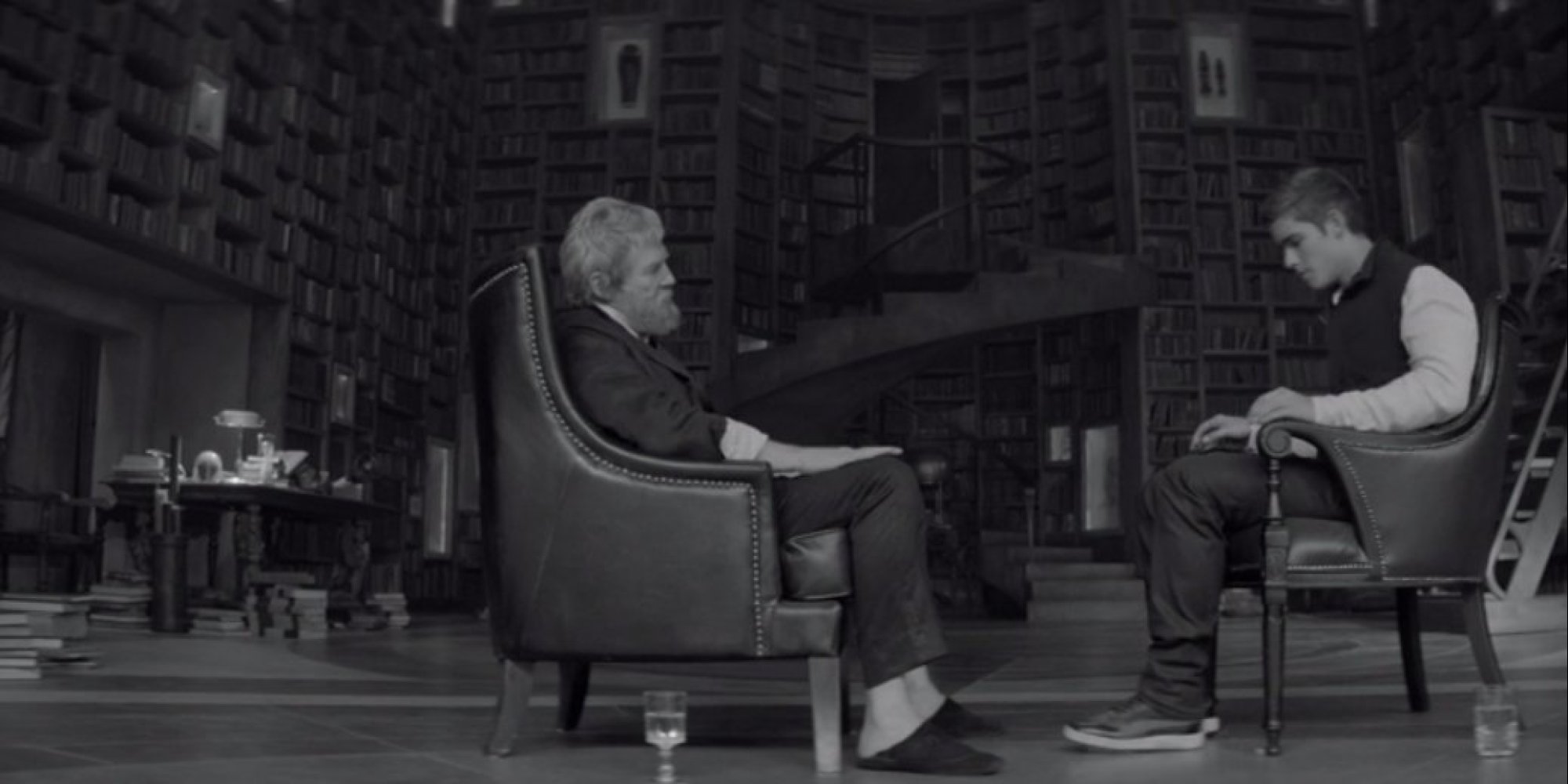
And this is something film could not replicate. Filming the movie in black and white tips you off that something is wrong. Again, the world ISN’T black and white. It’s colorless. The characters lack the ability to understand the contrast. The whole devise relies upon the reader needing to imagine the world on their own. The moment a film maker’s vision intervenes on behalf of the reader, the power of the revelation is dampened.

Oh yeah. This clearly looks normal. This CAN'T be symbolism!


Personally, this is something I love about The Giver. We live at a time where people use movies to substitute for reading. Or where people rely upon films to visualize stories. Sometimes it can be hard to argue with them that the best way to experience the visual aspect of a story isn’t through visual media. To me, The Giver is potent proof that the power of a reader’s imagination is even greater than the power of film.

Sunday, January 11, 2015

Writerly News: Masters of the Universe

Okay!

So the blog has been a bit sparse for updates lately, but for good reason.

Right after I wrote my last post - the one mentioning my course in seriated speculative fiction (oh, how could you forget?) I got a nice surprise in terms of current "life trajectory." My older sister needed some help with her children, due to her husband getting a long distance job. He would be commuting for the next several months, home only on week-ends, and so poor big sis would be all by her lonesome.

EXCEPT SHE WASN'T!!! Why? Well, because instead, yours truly flew to the other side of Canada to be with her. What resulted was a whirlwind trip where I finished my Masters, wiped my nephew's noses, helped my sister move from Montreal to Ottawa and then, to cap it all off, I flew out to Halifax to celebrate Christmas with my brother's family.

So with my past several months amounting to a "who's-who" of Canadian cities, I didn't have much time for blogging. With how limited my free time was, I tended to need to be either working on school assignments, or plugging away at revisions on other manuscripts. I do enjoy keeping this blog, but at the end of the day, I'm a fiction writer and that has to serve as my priority. Also, I figure you're all so used to my erratic update schedule that in some sense, I would "get away with" these blogging transgressions.

Oh and did you notice something up there?

Behold the thesis!
So technically I defended this thesis all the way back in April and this photo is almost a year old, but whatever. I do my Master's in my own order. The point is that I am done! Yes, the day you are waiting for has come. You may all refer to me as "Master and Dark Lord of the seven realms of Children's Literature." I'm pretty sure Chatham stipulated somewhere that this was the official title given to graduates of my discipline.

Obviously, this is an exciting time. I'm thrilled to be done, and yet still close to those I shared my program with. I'm thrilled to have been a part of Chatham. And it also means that now I'm looking forward to whatever comes next. I'm still in eastern Canada, and we'll see how that goes. Maybe there's something exciting for the Little Writer That Could to do here. Like drown in the snow.

What does that mean for this blog? Hopefully more regular updates. And luckily... I still want to do the series I promised you! So stay tuned for those promised posts on seriated speculative fiction. Don't worry. You'll get all the goods from me. You'll be sick of it in no time.


Wednesday, September 17, 2014

Writerly News: Why you wish you were taking Seriated Speculative Fiction

It's been a bit longer than I'd hoped between blog posts, mostly due to technical difficulties.

I own a laptop, (I call it Critter) that is mighty in soul but not in body. Critter's actual computer-y components work fine. It's just exceptionally fragile and prone to crumbling. When I first received Critter, it got so excited it's hinges started bursting apart. With some creativity and a few coats of glue, we've managed to weather a few years without any major incidents, but the end of this summer proved to be the time when Critter threw in the towel. Once again, the inner computer worked fine, but the metal that joins the power cord and the inner computer decided to break and pop out after I did a whole lot of nothing to it.

Luckily, the laptop doctors managed to fix Critter up and Critter has since returned home, slathered in a fresh coat of glue (seriously. There is additional glue on my computer. Along with replacing the part that broke, they generously squirted more glue on Critter) and humming away happy as ever.

This all happened just in time for my Twitter account to malfunction and lock itself up for several weeks. So while I could finally write again, I had limited options for alerting people of blog updates. Mercifully, the account is back to normal again. So I now have a healthy computer and a healthy connection to the my interwebs "presence" (such as it is).

At the same time, the usual September business engulfed me as I moved to a new job and, even more importantly, into the final semester of course work for my Masters degree! It feels very exciting and I've worked towards this for a long time. So hurray. :)

As my writing life is once again being dictated by course work, I thought it might be fun to switch up some of my posts to reflect what I'm working on, especially since my final classes are SO COOL!!!

Due to the fact that I am currently working with my school by distance, my final course is something of a self-directed study. It's half literature/readings course and half writing/workshop seminar and since I'm the only student, its somewhat tailored to my interests.

So what is this mystery class? (Other than fabulous, of course)

I have proudly and pretentiously titled it: Seriated Speculative Fiction

But what does that MEAN?? Well, to those uninitiated in the jargon of University Creative Writing, "seriated" means "something that comes in a series" and "speculative fiction" is basically code for "science-fiction and fantasy, but we're calling it something else because SERIOUS writers keep making fun of us for writing science-fiction and fantasy."

This is a pretty special kind of course to do. Most of the time in English literature courses, there are a lot of confines on what you do and don't have time for. I took a class in my first semester on English novels that prominently feature manor houses and use them as a thematic element. Yes, that sounds really specific, but there was still plenty that was being left out by the course. The novels were dense and we only had time for five. Also, it turns out a LOT of people have written novels about crumbling English manors. When you think about it in those terms, it's easy to see that I could have done a whole course on just Charles Dickens featuring manor houses as a strong thematic element. But of course, in order to do the topic justice, our teacher chose breadth and we read five different authors, just one book by each.

Last year I studied Young Adult literature, which was a fantastic course, but there the subject matter was even broader. We plowed through over a dozen novels for this course, but again, there was only time for one book by each author. This meant, for instance, that when we were covering the topic of science fiction and dystopia, our professor had us read The Hunger Games but neither of the books that followed. Frankly, it's difficult to make time for a series within a class, unless you're studying the work of a single, specific author. (Example: I took a course on August Wilson, one of Pittsburgh's favorite sons, and we read his entire Pittsburgh Century Cycle. But unless you're a two time Pulitzer winning playwrite, like Wilson, it's unlikely you'll get to read every work by a single author.)

But as a science fiction and fantasy writer, the topic of the "series" is a highly relevant topic for someone like me. Certainly there are stand alone novels within these genres, but a large number of the most "important" works within sci-fi and fantasy are series. With authors creating whole new worlds, isn't it natural to use those worlds for as many stories as possible? The pattern is obvious as early as The Lord of the Rings or The Chronicles of Narnia and not much has changed since.

On top of that, in my first year in my program, I wrote a sci-fi/fantasy novel, which I then had to put on the back burner so that I could finish my thesis the following year. But I'd confided to my thesis director that I did have ideas for a second book in the same series and she's been looking for an excuse to teach a course like this - one that focuses on how a series builds over time rather than as stand alone novels.

And so here I am! Studying the coolest thing ever and writing some of my own *ahem* seriated speculative fiction on the side. I'll be reading three full series for the course, each published relatively recently and each aimed at a different age group. And as I finish each, I plan on posting a few of my thoughts about the series as a whole and what can be learned from them. So for those reading along, the series are as follows!

As my middle grade series, I will be studying The Giver Quartet by Lois Lowry

Because reading it for YA lit clearly wasn't enough, my YA series will be The Hunger Games Trilogy by Suzanne Collins

And ending the year, I will tackle the adulty adultness of The MaddAddam Trilogy by Margaret Atwood

I just finished up The Giver, so expect a follow up post to this one coming soon! Until then, happy seriated speculative fiction to all!

Friday, August 15, 2014

Book Reviews - The Night Gardener

The Night Gardener
With the potato famine in full, terrible glory, a pair of Irish siblings are destitute and looking for work. The jobs they finally secure at a crumbling English manor, deep in the ominously named Sourwoods, are their only way of staying out of an orphanage.

But the longer they stay in the house, the clearer it becomes that every bystander who warned them to avoid the road into the Sourwoods might have been right to be superstitious. Illness lurks inside the house and a stranger prowls the grounds at night.

And then there is the tree. The great, terrible, black tree, growing beside the manor house...

What makes it so good:

So I have a bit of a history with this book! This review is probably going to be part review, part self-indulgent reveling in the past. You have been warned!

I had just started attending classes at Chatham University. I was living the dream, studying what I'd wanted to since grade school. Creative writing. Better than that, creative writing, with my primary genre focus being writing for children and young adults.

One of my foundation classes was therefor in Children's Literature, taught by Jonathan Auxier. You might recognize him as the gent whose name is directly below the night gardener's feet on the  book's cover. At the time, this book was a year and a half away from release and Jonathan was knee-deep in revisions. And that, friends, is very deep. He's a tall man.

As a result, The Night Gardener was one of the first books I've ever had any insight into the "journey" of. As one of his students, we certainly weren't the ones giving critique and feedback on it in its infancy. We heard little snippets. What it was like working with an editor on a novel-in-progress, what writing a duel point-of-view novel meant. How important it was to start your second book as soon as possible after the release of your first.

And our reading list, it turns out, consisted of numerous titles that eventually made it into the author's note at the end of The Night Gardener - books like Something Wicked this way Comes and The Secret Garden. *coughI think someone might have had ulterior motives for making us read and discuss those bookscough*

But that's actually one of the reasons I wanted to cover this book now! On the heels of the earlier discussion of books that are "derived" from earlier sources rather than "derivative" of them, I thought it would be fun to discuss books that are very upfront about their literary influences and which can only be described as reveling in those connections.  The Night Gardener is among them.

I recently discussed with someone whether or not Gardener could be considered historical fiction. Certainly the history and the setting play into the richness of the story. And even the more fantastical, horror elements harken back to the Victoria era. As Auxier says in his own author's note, the era was one of rapid scientific discovery, but also fascination with the spiritual and occult, something The Night Gardener plays with.

But overall, I couldn't conclude that it was historical fiction. Usually the genre is interested in teaching something about the past as one of it's primary goals, and I never got the sense The Night Gardener held this as its motive. This book isn't trying to teach the reader something about the "facts" of the Victorian era - it's aiming to teach you about it's stories.

Among the characters are two story-tellers. First, the old Hester Kettle, a vagabond story teller who always seems to know more than she should, and second, one of novel's heroes, Molly. Only fourteen, Molly is still learning the difference between a story and a lie. 

That a story this steeped in literature and the history of children's books also comes with a satisfying element of horror meant that I loved the book. And this isn't bias speaking, either! This isn't Jonathan's first book, but in my humble opinion, it is his best. All the elements just came together beautifully - the horror, the old fashioned prose, the characters. It's all there. It's funny, touching and terrifying. I highly recommend it.

What might make it better:

This is a very, very long and very, very verbose children's book.

For me, it works. The reading level isn't easy, and while it's a quick read, it isn't as quick as some comparable books. To give an idea, Neil Gaiman is well known for his children's scary stories. Coraline, definitely a Middle Grade book, is only 30,000 words. The Graveyard Book sort of straddles the line between Middle Grade and Young Adult, and is around 67,000. Definitely on the longer end of Middle Grade, but okay for the anticipated audience. The Night Gardener clocks in at over 79,000 words. It also straddles the line between YA and MG, but I think it's pretty clear that for some kids, that's a lot of reading.

Tonally, it still reads like a Middle Grade book rather than YA, but with it's dark subject matter and hefty sentences, it's not going to be a breeze for all children. Still, I think it does fill a niche that a lot of people worry about in children's literature. I hear plenty of people who love books bemoan that we no longer get books for children like The Hobbit. They usually say something like this:

"When I was eleven, I read all of Tolkien's Lord of the Rings books! I wanted to be challenged. These kids books today, they just aren't challenging. Have you read Twilight? Way too easy! Such bad writing."

First, I'm not saying that The Night Gardener necessarily bares a lot in common with The Hobbit or Twilight. It's just that most of my friends are sci-fi/fantasy nerds and they all somehow think it makes sense to compare epic fantasy to paranormal romance (it doesn't). I thought it had more in common with older books - ones like those by Robert Louis Stevenson and Charles Dickens which, again, people wished children read. Or were prepared to read. This is exactly the type of book that introduces the wonder and creepiness of the Victorian era to young readers.

Second, I don't personally believe that a book being an "easy" read or not is the same as whether or not it's good or bad. Charlotte's Web is a very easy book and its completely brilliant. But there is something to be said for a book that gets its beauty from its use of complex language. To give you an idea of what The Night Gardener challenges its reader with, I spent a lot of the book trying to remember what a dumbwaiter is.

Behold the dumbwaiter!
If you know what a dumbwaiter is, or if you know a child who would like to learn that sort of thing, then don't worry about the length or the words. I do feel the need to add  that the book IS creepy, scary and at times, down right violent. Nothing Auxier included felt gratuitous to me. Any horror story has to include some actual horror, but take that into account. It is shelved among the children's books and while it belongs there, and I'm glad of its presence, its scares are not to be taken lightly. Again, think Coraline and The Graveyard Book and Something Wicked this way Comes.

And in general, do read it. And think of the wonderful tradition of stories that it places itself a part of. Think of the history of books we draw from, and how we all derive something from that history.

Wednesday, August 6, 2014

Derived VS Derivative: In Defense of Divergent

Try saying that title ten times fast.

I went for the movie poster rather than book cover because THEO JAMES!!!

Today, I'm talking about Divergent by Veronica Roth. I'm also talking about story and influence and what makes an idea "new" vs "tired and done." This won't be the last time either, so stay tuned! Today, I'm focusing on a book that catches a lot of flack for bearing similarities to others on the market and making an argument for why it deserves the love it gets anyway.

For those who don't know Divergent, here's the quick rundown:

Beatrice Prior is a sixteen-year-old girl living in a futuristic, dystopian Chicago. She's been raised in a society where people are segregated based on what virtue they most strongly identify with, whether that virtue is courage, truthfulness, kindness etc. These segregated groups are called factions and Beatrice belongs to Abnegation, the faction that bases its identity around service. While she admires those she lives among, she also feels stifled by the high level of self-denial the Abnegation insist on.

She hopes her faction test will help her make some sense of these feelings, as her choosing ceremony is coming up and she'll have to decide whether she remains in her own faction or transfers to another one. But when her test results come up inconclusive and she is forced to confront the possibility that she doesn't belong to any one faction, her understanding of her world begins to unravel...

Okay, so there's my version of the dust-jacket blurb. It gives a decent idea of what the book is about, but there is a much shorter version of the Divergent blurb that could also be given:

Divergent is Harry Potter's Hogwarts houses recast in a gritty, Hunger Games-esque environment.

And honestly, it's not a bad description of the book either.

This is where Divergent has hit some snags and criticism. Hot on the heels of Hunger Games and featuring a story mechanic reminiscent of another recent kidlit sensation, many critics are dismissing Roth's series as derivative and phoned in. The premise isn't unique enough and the books are just copycats.

Roth clearly did derive a number of her novel's elements from Hunger Games and Harry Potter. She's been very public about the fact that Harry Potter is one of her favorite books and dystopia is greatly overshadowed by Suzanne Collins's trilogy right now. But books are more than the sum of their parts, and this is especially the case with Divergent. Just because some of her novel's landscape can be traced back to other books doesn't mean that there isn't something unique on offer in Dystopian Chicago. So here are those two most common criticisms and some arguments for why they aren't quite fair.

#1: The factions are just Hogwarts houses but darker.
This, I would argue, is one of the strengths of the books. I'm a huge Harry Potter fan, but even as a child, something about the Hogwarts houses bothered me. For instance, pretty much every villain the story saw came from one house - Slytherin. During the final battle for Hogwarts, Rowling states very clearly how many of each particular house stick around to defend the school. Courageous Gryffindors make up the largest amount, followed by hardworking Hufflepuffs. A smaller fraction of intelligent Ravenclaws stay and then, of course, ambitious Slytherin is absent because they're all evil.

If Roth did base her factions on the Hogwarts houses, she recognized that there were some problems with this clear-cut way of looking at virtue. The Dauntless Faction, for instance, value courage just like Gryffindor, but Roth's version points out that courage is only useful if it is placed in correct principles. And being gumptious and willing to jump into action when it is demanded is not a guarantee that someone is going to always know WHAT the right thing is. Dauntless is largely divided between those who value the power that comes from bravery and those that value the heroism.

Similarly, the ambition of Slytherin is in many ways at it's most dangerous when it's combined with the intelligence of Ravenclaw. Erudite Faction represents a more complicated fear - one of logic overwhelming principle. I'm not sure I entirely agree with her version of these virtues, but she does devote a lot of time to arguing her views, something I do value.

Roth's books engage the notion of a society organized by cardinal virtues more deeply than the Harry Potter books, sometimes with directly opposing points. In other words, she adds to the discussion. Whether you agree with her or Rowling, she does at least force some questions about just what drives someone to evil and what weaknesses are inherent in what we call our strengths.

#2: The plot is just another Hunger Games knock-off.
This criticism has a bit more bearing, and I can definitely see some similarities. There's something familiar about the pacing of the books and the dark, grittiness. It is a dystopia and there is a "stop the evil empire" plot and there are children put through recklessly dangerous tasks that our heroine, Tris, must "win" in a matter of speaking.

But there are some important differences, most of them coming down to a character level. Tris and Katniss are very different from each other and they confront their problems in very different ways. Katniss is constantly worried about the damage she might cause in someone's life, and so holds people at a distance, more comfortable using them for survival than receiving affection. Tris, on the other hand, actively pursues acceptance and new friendships. She wants a normal life, and incidentally, lives in a world where she's got a better chance at one.

Yes, the worlds are different too. Chicago's system might be broken, but it's no punitive dictatorship like Panem. As the novels go on, she's not even sure the answer is to end the faction system, since she can see the good and the structure that have come from it. Really, there IS no hope for Katniss within the status quo, so resisting the Capitol is an easy decision... or would be if Katniss was good at making moral decisions. Another key Katniss/Tris difference. Tris is much more idealistic and much more in control of her own destiny.

In fact, if you're looking for the king of Hunger Games knock-offs, I would say you don't need to look any further than Catching Fire, the second book in Collins' trilogy, which is almost identical in plot to the first one. One of Divergent's greatest strengths is its second book, Insurgent, which steps away from the plot line of the first by developing the encroaching war in an interesting, detailed way. The same issues are not rehashed and Tris's relationships with other characters grow and change in ways not seen in the first book. As the story goes on, the more Divergent and the Hunger Games - ahem - diverge. And that is very satisfying. Once again, it might have started in a similar place, but Divergent adds something to the conversation of YA fiction.

Divergent isn't the only YA book that gets accused of being derivative. As paranormal romance and dystopian sci-fi have ran their course, numerous books have come and gone that bare resemblance to one another. Now, we're even starting to see editors and lit agents mention not wanting another "sick child" or "cancer" novel because John Green's The Fault in Our Stars is too ubiquitous.

But all of these books owe their lineage to earlier stories. It's one of the outcomes of living in the world we do. There are thousands of years of stories preceding the ones currently bought and sold in your local Barnes and Noble. Hunger Games has been accused of being derivative of an earlier Japanese film, Battle Royale, but its origins can be traced to an even earlier time. Collins has stated explicitly that she was inspired by the story of Theseus and the Minotaur, in which youths where abandoned inside a maze with a monster and only one made it out alive. With her use of Greek and Roman names and imagery, its clear that Collins did derive much from these books, just as Divergent derives much from earlier stories. But they aren't derivative.

For me, the bench mark is the one I've stated a couple of times already - does the work of art bring something new to the conversation? Is it using the literary tropes already common in fiction in a new way? Is it reminding us of another way of thinking about a topic, one relevant to the way the world is today? If you can answer "yes" to any of these questions, then I would argue the book is derived, not derivative.

So what then if you can't? What if a book adds nothing to the discussion? Or what if an element of the story adds nothing to where it is borrowed from? Well, stay tuned, folks. As mentioned, there's more to come.

Tuesday, July 29, 2014

Topical Topic = On Not Finishing Books

For a long time, I did a lot of guilt over books that I didn't finish. I think this reaction came from the way books are presented at school, where it is a mortal sin to leave books unfinished, no matter how much you dislike them. You get bad marks for that kind of thing.

As a result, leaving books unfinished left a stale taste in my mouth, one that drove me to such guilt that, yes, I often balked at reading for fear I would be stuck with a book I didn't like, but HAD to finish. It was a little like never loving for fear of heartbreak.

After starting my MFA, I think my feelings have shifted quite a lot. First, let me say that I have read more books that I've disliked or even hated, in the last two years than at any other point in my life. But I've also been exposed to some new favorites I never would have known to try otherwise. When you're studying literature, for every Howard's End there will also be a The Chocolate War assigned to you. (Yes, I hated one of those books) That's just the subjective nature of reading.

Obviously, I had to finish the books I loathed, but all the same, I've found my perspective shifting around the topic of leaving other books unfinished. During the summers, I am much more likely to get a few chapters into a novel and then ditch it. Permanently. I do this for a few reasons, upon which I shall expound.

1) I will read enough books I don't like during the school year to more than likely make my quota.
This might sound snarky, but I mean it truthfully. There IS a lot of use to occasionally reading books I don't like. From those books, I learn what I don't want to do in my own writing. They force me to work the part of my brain that wants to "fix" plot problems, pacing or word choice. That's a useful muscle for me to use. Also, these books will usually still have some strong elements, and those can be worth learning from. All the same, I think I learn more from reading books that I DO connect with - the ones I want to emulate. The bulk of my time should go into reading those. Even in the summer, time is limited, so I don't waste it on filling the "bad book quota."

2) If I'm not occasionally tossing aside a book I don't like, it means I'm not reading widely enough.
As a child, I went through phases where all I ever read was Brian Jacques's Redwall series or Rowling's Harry Potter. I knew I would like these books and I wasn't wrong. In general, I can usually bet that if a book is a Young Adult or Middle Grade Fantasy or stars animals, I will probably like it. Sure there are exceptions, but these are safe choices.

But reading shouldn't always be safe. It should challenge us emotionally and intellectually and often that is best done with books outside our comfort zones. Last summer I made an effort to read more YA contemporary, not really my area or my "thing." One book I hurled across the room at chapter 5, but another was John Corey Whaley's Where Things Come Back and that made me sob happy tears. It stretched me as a reader and as a writer. Reading deeply and widely is an important part of developing a voice. But outside my usual genres, I know I'll also find more things I don't click with. There's a reason that I love animal and fantasy books and a reason why I write them. Some books will be good enough to transcend those barriers of personal preference. Others will be returned to the library early amid rants of disappointment.

3) Just as you can learn a lot from a bad book, you can learn a lot from an unfinished book.
Last year, I read one book that wasn't bad or outside my genre and it... lost me. The pacing dragged and I just couldn't be bothered with finishing it. That was when the importance of editing for length in an adventure story REALLY hit me. At over 120,000 words, this book had too much bogging down the story. I had a hard time imagining it ever picking up to a satisfactory clip and so eventually I returned it to the library. As a long winded author, it was a hard lesson to learn. Other books I've put down because their openings were confusing or contrived or uninteresting. Others lost me with an uneven middle or bothersome content choices. All valuable lessons.

But the number one reason I don't finish books is...

4) The library thought they owned the thing or something.
Seriously, guys. My library does this ALL THE TIME. They let me take away a book but then they seem to think they still own it or something and start sending emails asking for it back. But in all seriousness, this is an interesting category. Sometimes these books are the ones that show the difference between a 4 or a 5 star book in my rankings. No matter how little time I have, I will always finish a 5 star, even if that means facing late fees. A 4? Well, I may check it out again. I may not. Generally, it's yet another reminder of how subjective this whole reading business is.

So those are MY reasons for leaving books unfinished. What about the rest of you? Any others?