It's been a bit longer than I'd hoped between blog posts, mostly due to technical difficulties.
I own a laptop, (I call it Critter) that is mighty in soul but not in body. Critter's actual computer-y components work fine. It's just exceptionally fragile and prone to crumbling. When I first received Critter, it got so excited it's hinges started bursting apart. With some creativity and a few coats of glue, we've managed to weather a few years without any major incidents, but the end of this summer proved to be the time when Critter threw in the towel. Once again, the inner computer worked fine, but the metal that joins the power cord and the inner computer decided to break and pop out after I did a whole lot of nothing to it.
Luckily, the laptop doctors managed to fix Critter up and Critter has since returned home, slathered in a fresh coat of glue (seriously. There is additional glue on my computer. Along with replacing the part that broke, they generously squirted more glue on Critter) and humming away happy as ever.
This all happened just in time for my Twitter account to malfunction and lock itself up for several weeks. So while I could finally write again, I had limited options for alerting people of blog updates. Mercifully, the account is back to normal again. So I now have a healthy computer and a healthy connection to the my interwebs "presence" (such as it is).
At the same time, the usual September business engulfed me as I moved to a new job and, even more importantly, into the final semester of course work for my Masters degree! It feels very exciting and I've worked towards this for a long time. So hurray. :)
As my writing life is once again being dictated by course work, I thought it might be fun to switch up some of my posts to reflect what I'm working on, especially since my final classes are SO COOL!!!
Due to the fact that I am currently working with my school by distance, my final course is something of a self-directed study. It's half literature/readings course and half writing/workshop seminar and since I'm the only student, its somewhat tailored to my interests.
So what is this mystery class? (Other than fabulous, of course)
I have proudly and pretentiously titled it: Seriated Speculative Fiction
But what does that MEAN?? Well, to those uninitiated in the jargon of University Creative Writing, "seriated" means "something that comes in a series" and "speculative fiction" is basically code for "science-fiction and fantasy, but we're calling it something else because SERIOUS writers keep making fun of us for writing science-fiction and fantasy."
This is a pretty special kind of course to do. Most of the time in English literature courses, there are a lot of confines on what you do and don't have time for. I took a class in my first semester on English novels that prominently feature manor houses and use them as a thematic element. Yes, that sounds really specific, but there was still plenty that was being left out by the course. The novels were dense and we only had time for five. Also, it turns out a LOT of people have written novels about crumbling English manors. When you think about it in those terms, it's easy to see that I could have done a whole course on just Charles Dickens featuring manor houses as a strong thematic element. But of course, in order to do the topic justice, our teacher chose breadth and we read five different authors, just one book by each.
Last year I studied Young Adult literature, which was a fantastic course, but there the subject matter was even broader. We plowed through over a dozen novels for this course, but again, there was only time for one book by each author. This meant, for instance, that when we were covering the topic of science fiction and dystopia, our professor had us read The Hunger Games but neither of the books that followed. Frankly, it's difficult to make time for a series within a class, unless you're studying the work of a single, specific author. (Example: I took a course on August Wilson, one of Pittsburgh's favorite sons, and we read his entire Pittsburgh Century Cycle. But unless you're a two time Pulitzer winning playwrite, like Wilson, it's unlikely you'll get to read every work by a single author.)
But as a science fiction and fantasy writer, the topic of the "series" is a highly relevant topic for someone like me. Certainly there are stand alone novels within these genres, but a large number of the most "important" works within sci-fi and fantasy are series. With authors creating whole new worlds, isn't it natural to use those worlds for as many stories as possible? The pattern is obvious as early as The Lord of the Rings or The Chronicles of Narnia and not much has changed since.
On top of that, in my first year in my program, I wrote a sci-fi/fantasy novel, which I then had to put on the back burner so that I could finish my thesis the following year. But I'd confided to my thesis director that I did have ideas for a second book in the same series and she's been looking for an excuse to teach a course like this - one that focuses on how a series builds over time rather than as stand alone novels.
And so here I am! Studying the coolest thing ever and writing some of my own *ahem* seriated speculative fiction on the side. I'll be reading three full series for the course, each published relatively recently and each aimed at a different age group. And as I finish each, I plan on posting a few of my thoughts about the series as a whole and what can be learned from them. So for those reading along, the series are as follows!
As my middle grade series, I will be studying The Giver Quartet by Lois Lowry
Because reading it for YA lit clearly wasn't enough, my YA series will be The Hunger Games Trilogy by Suzanne Collins
And ending the year, I will tackle the adulty adultness of The MaddAddam Trilogy by Margaret Atwood
I just finished up The Giver, so expect a follow up post to this one coming soon! Until then, happy seriated speculative fiction to all!

Writerly thoughts from writerly writer, Emily Paxman.
Showing posts with label middle grade fiction. Show all posts
Showing posts with label middle grade fiction. Show all posts
Wednesday, September 17, 2014

Friday, August 15, 2014
Book Reviews - The Night Gardener
 |
| The Night Gardener |
But the longer they stay in the house, the clearer it becomes that every bystander who warned them to avoid the road into the Sourwoods might have been right to be superstitious. Illness lurks inside the house and a stranger prowls the grounds at night.
And then there is the tree. The great, terrible, black tree, growing beside the manor house...
What makes it so good:
So I have a bit of a history with this book! This review is probably going to be part review, part self-indulgent reveling in the past. You have been warned!
I had just started attending classes at Chatham University. I was living the dream, studying what I'd wanted to since grade school. Creative writing. Better than that, creative writing, with my primary genre focus being writing for children and young adults.
One of my foundation classes was therefor in Children's Literature, taught by Jonathan Auxier. You might recognize him as the gent whose name is directly below the night gardener's feet on the book's cover. At the time, this book was a year and a half away from release and Jonathan was knee-deep in revisions. And that, friends, is very deep. He's a tall man.
As a result, The Night Gardener was one of the first books I've ever had any insight into the "journey" of. As one of his students, we certainly weren't the ones giving critique and feedback on it in its infancy. We heard little snippets. What it was like working with an editor on a novel-in-progress, what writing a duel point-of-view novel meant. How important it was to start your second book as soon as possible after the release of your first.
And our reading list, it turns out, consisted of numerous titles that eventually made it into the author's note at the end of The Night Gardener - books like Something Wicked this way Comes and The Secret Garden. *coughI think someone might have had ulterior motives for making us read and discuss those bookscough*
But that's actually one of the reasons I wanted to cover this book now! On the heels of the earlier discussion of books that are "derived" from earlier sources rather than "derivative" of them, I thought it would be fun to discuss books that are very upfront about their literary influences and which can only be described as reveling in those connections. The Night Gardener is among them.
I recently discussed with someone whether or not Gardener could be considered historical fiction. Certainly the history and the setting play into the richness of the story. And even the more fantastical, horror elements harken back to the Victoria era. As Auxier says in his own author's note, the era was one of rapid scientific discovery, but also fascination with the spiritual and occult, something The Night Gardener plays with.
But overall, I couldn't conclude that it was historical fiction. Usually the genre is interested in teaching something about the past as one of it's primary goals, and I never got the sense The Night Gardener held this as its motive. This book isn't trying to teach the reader something about the "facts" of the Victorian era - it's aiming to teach you about it's stories.
But overall, I couldn't conclude that it was historical fiction. Usually the genre is interested in teaching something about the past as one of it's primary goals, and I never got the sense The Night Gardener held this as its motive. This book isn't trying to teach the reader something about the "facts" of the Victorian era - it's aiming to teach you about it's stories.
Among the characters are two story-tellers. First, the old Hester Kettle, a vagabond story teller who always seems to know more than she should, and second, one of novel's heroes, Molly. Only fourteen, Molly is still learning the difference between a story and a lie.
That a story this steeped in literature and the history of children's books also comes with a satisfying element of horror meant that I loved the book. And this isn't bias speaking, either! This isn't Jonathan's first book, but in my humble opinion, it is his best. All the elements just came together beautifully - the horror, the old fashioned prose, the characters. It's all there. It's funny, touching and terrifying. I highly recommend it.
What might make it better:
This is a very, very long and very, very verbose children's book.
For me, it works. The reading level isn't easy, and while it's a quick read, it isn't as quick as some comparable books. To give an idea, Neil Gaiman is well known for his children's scary stories. Coraline, definitely a Middle Grade book, is only 30,000 words. The Graveyard Book sort of straddles the line between Middle Grade and Young Adult, and is around 67,000. Definitely on the longer end of Middle Grade, but okay for the anticipated audience. The Night Gardener clocks in at over 79,000 words. It also straddles the line between YA and MG, but I think it's pretty clear that for some kids, that's a lot of reading.
Tonally, it still reads like a Middle Grade book rather than YA, but with it's dark subject matter and hefty sentences, it's not going to be a breeze for all children. Still, I think it does fill a niche that a lot of people worry about in children's literature. I hear plenty of people who love books bemoan that we no longer get books for children like The Hobbit. They usually say something like this:
Tonally, it still reads like a Middle Grade book rather than YA, but with it's dark subject matter and hefty sentences, it's not going to be a breeze for all children. Still, I think it does fill a niche that a lot of people worry about in children's literature. I hear plenty of people who love books bemoan that we no longer get books for children like The Hobbit. They usually say something like this:
"When I was eleven, I read all of Tolkien's Lord of the Rings books! I wanted to be challenged. These kids books today, they just aren't challenging. Have you read Twilight? Way too easy! Such bad writing."
First, I'm not saying that The Night Gardener necessarily bares a lot in common with The Hobbit or Twilight. It's just that most of my friends are sci-fi/fantasy nerds and they all somehow think it makes sense to compare epic fantasy to paranormal romance (it doesn't). I thought it had more in common with older books - ones like those by Robert Louis Stevenson and Charles Dickens which, again, people wished children read. Or were prepared to read. This is exactly the type of book that introduces the wonder and creepiness of the Victorian era to young readers.
Second, I don't personally believe that a book being an "easy" read or not is the same as whether or not it's good or bad. Charlotte's Web is a very easy book and its completely brilliant. But there is something to be said for a book that gets its beauty from its use of complex language. To give you an idea of what The Night Gardener challenges its reader with, I spent a lot of the book trying to remember what a dumbwaiter is.
 |
| Behold the dumbwaiter! |
And in general, do read it. And think of the wonderful tradition of stories that it places itself a part of. Think of the history of books we draw from, and how we all derive something from that history.
Thursday, January 30, 2014
The True Blue Scouts of Sugar Man Swamp - Book Reviews
A Texan Bayou, a pair of young raccoons, a world famous gator wrestler, the legendary Sugar Man himself and a whole mess of wild hogs running your way. If that doesn't get you excited, well then, brothers and sisters, I don't know what will.
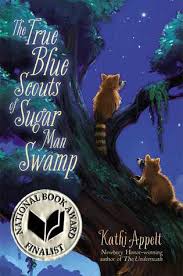
Available on Amazon
What makes it so good:
Kathi Appelt's novels came across my line of vision as I started prepping for my thesis. My own project is a Middle Grade novel about domestic cats, which also happens to feature a raccoon as a supporting character. Well, this novel is sort of an inversion of that. Its primary heroes are a pair of raccoon brothers - brave Bingo and fastidious J'miah - and among the supporting cast is a domesticated cat, the often ignored Sweetums. But here the similarities start to fall away, which I am very glad of, since I would hate to have to live up to this novel by tredding the same path!
Yes, it is that good. Scouts is delightful start to finish and Kathi Appelt's novels are a masterclass in "what literary middle grade fiction looks like." Her work is oozing with voice and personality. In the case of Scouts, this comes in the form of an omnicient narrator that bounces back and forth between the many disperate story threads. At one moment the narrator might be following the efforts of Bingo and J'miah to wake the Sugar Man and the next, it will be detailing the dastardly exploits of the greedy land developer who wants to turn the swamp into a gator wrestling park.
But the whole story is tied together by that one narrator, whoever it is. The story is told like an old American Tall Tale, the kind you might hear on an old fashioned radio show. This isn't a book that addresses it's "readers." It's got "sports fans" and "mothers and fathers." To say the least, I was sold on the book the moment I got to the end of the first chapter and read this:
"Every denizen of the swamp knew that the wrath of the Sugar Man was something to avoid.
He also had a rattlesnake pet, Gertrude.
Crotalus horridus GIGANTICUS (also known as CHG).
Brothers and sisters, the stakes were high."
To say the least, the book demands to be read aloud and I've heard the audiobook is fantastic. If you do read it aloud, don't be surprised if you find yourself accidently speaking in your best approximation of a Southern Accent. You can just feel your old grandpappy telling you this story on his back porch.
On top of that, the action is fun and exciting, the characters are charming and memorable and the ending is oh so satisfying. This book is very worthy of the pile of awards being heaped on its head.
What might make it better:
If those looping, twisting plot threads sound confusing, then rest assured, Appelt takes the time to catch her readers up. In the end, it's actually pretty straight forward. Indeed, most criticisms I've seen of the book were that it can get repetitive. Take the story of the wild hogs, for instance. Numerous times the narration bounces back to the hog family, all running towards Sugar Man Swamp, hoping to get a mouthful of the famous, delicious cane brake sugar. And honestly, the action never changes much in the scenes involving them. Every time you see the pigs they are still running towards that same swamp chapter after chapter. Each one of those chapters really do read about the same.
Now, this personally didn't bother me. I thought the hogs were hilarious and they added another layer of personality and comedy to the book. But I can see where repetitive scenes and descriptions like these might not work for some readers. I think whether or not this becomes a problem for you depends on how much you connect with the voice. I was there 100%, but for someone less keen, there are quite a few moments that don't exactly move the plot along.
Really, these asides reminded me of watching a stand-up comedian whose gone off on a thread away from his main joke. If you think he's great, you will watch him ramble and be perfectly happy. It might even be where some of your favourite parts of his sketch are. But those who are less sold, I think, find themselves wondering when he's going to make his flippin' point.
Books often have those moments too. How long we're willing to let the plot be derailed is often a function of how much we like the way the story is being told. If we love the world the author has created - through voice, setting, character, you name it - we'll have more patience waiting for the plot to take over again.
For a good example of this in action in another book (or series, as the case may be) I submit the Harry Potter series. There's a noticable switch around book 4 where the books about doubled in length. Previously, Harry's adventures had to be tight and generally focused on the over all plot. The first three books don't have very many wasted moments and remain pretty tightly focused on the over all action of the story. But by book 4 that changed. Rowling was famous and her fans wanted to remain in Harry's world as long as humanly possible. They wanted every detail of the lives of Harry and his friends. Here, again, Rowling had a fantastic voice (hers came more through world building and character, rather than a quirky narrator) that readers just wanted more and more of. So the trips to Hogsmead got longer, the Yule Ball got grander and the supporting cast grew and grew. If the later books aren't as tight as the first ones (they aren't), it's because we asked for it.
So returning to The True Blue Scouts of Sugar Man Swamp, maybe read the sample chapters on Amazon, and if you find yourself smiling at that folksy voice, get your hands on a copy. You will love it. If you think it's only okay, get your hands on a copy anyway. You'll probably still like it, just not think it's the best thing since sliced bread. No one seems to really dislike this books. It's more a matter of whether you adore it or not.
What makes it so good:
Kathi Appelt's novels came across my line of vision as I started prepping for my thesis. My own project is a Middle Grade novel about domestic cats, which also happens to feature a raccoon as a supporting character. Well, this novel is sort of an inversion of that. Its primary heroes are a pair of raccoon brothers - brave Bingo and fastidious J'miah - and among the supporting cast is a domesticated cat, the often ignored Sweetums. But here the similarities start to fall away, which I am very glad of, since I would hate to have to live up to this novel by tredding the same path!
Yes, it is that good. Scouts is delightful start to finish and Kathi Appelt's novels are a masterclass in "what literary middle grade fiction looks like." Her work is oozing with voice and personality. In the case of Scouts, this comes in the form of an omnicient narrator that bounces back and forth between the many disperate story threads. At one moment the narrator might be following the efforts of Bingo and J'miah to wake the Sugar Man and the next, it will be detailing the dastardly exploits of the greedy land developer who wants to turn the swamp into a gator wrestling park.
But the whole story is tied together by that one narrator, whoever it is. The story is told like an old American Tall Tale, the kind you might hear on an old fashioned radio show. This isn't a book that addresses it's "readers." It's got "sports fans" and "mothers and fathers." To say the least, I was sold on the book the moment I got to the end of the first chapter and read this:
"Every denizen of the swamp knew that the wrath of the Sugar Man was something to avoid.
He also had a rattlesnake pet, Gertrude.
Crotalus horridus GIGANTICUS (also known as CHG).
Brothers and sisters, the stakes were high."
To say the least, the book demands to be read aloud and I've heard the audiobook is fantastic. If you do read it aloud, don't be surprised if you find yourself accidently speaking in your best approximation of a Southern Accent. You can just feel your old grandpappy telling you this story on his back porch.
On top of that, the action is fun and exciting, the characters are charming and memorable and the ending is oh so satisfying. This book is very worthy of the pile of awards being heaped on its head.
What might make it better:
If those looping, twisting plot threads sound confusing, then rest assured, Appelt takes the time to catch her readers up. In the end, it's actually pretty straight forward. Indeed, most criticisms I've seen of the book were that it can get repetitive. Take the story of the wild hogs, for instance. Numerous times the narration bounces back to the hog family, all running towards Sugar Man Swamp, hoping to get a mouthful of the famous, delicious cane brake sugar. And honestly, the action never changes much in the scenes involving them. Every time you see the pigs they are still running towards that same swamp chapter after chapter. Each one of those chapters really do read about the same.
Now, this personally didn't bother me. I thought the hogs were hilarious and they added another layer of personality and comedy to the book. But I can see where repetitive scenes and descriptions like these might not work for some readers. I think whether or not this becomes a problem for you depends on how much you connect with the voice. I was there 100%, but for someone less keen, there are quite a few moments that don't exactly move the plot along.
Really, these asides reminded me of watching a stand-up comedian whose gone off on a thread away from his main joke. If you think he's great, you will watch him ramble and be perfectly happy. It might even be where some of your favourite parts of his sketch are. But those who are less sold, I think, find themselves wondering when he's going to make his flippin' point.
Books often have those moments too. How long we're willing to let the plot be derailed is often a function of how much we like the way the story is being told. If we love the world the author has created - through voice, setting, character, you name it - we'll have more patience waiting for the plot to take over again.
For a good example of this in action in another book (or series, as the case may be) I submit the Harry Potter series. There's a noticable switch around book 4 where the books about doubled in length. Previously, Harry's adventures had to be tight and generally focused on the over all plot. The first three books don't have very many wasted moments and remain pretty tightly focused on the over all action of the story. But by book 4 that changed. Rowling was famous and her fans wanted to remain in Harry's world as long as humanly possible. They wanted every detail of the lives of Harry and his friends. Here, again, Rowling had a fantastic voice (hers came more through world building and character, rather than a quirky narrator) that readers just wanted more and more of. So the trips to Hogsmead got longer, the Yule Ball got grander and the supporting cast grew and grew. If the later books aren't as tight as the first ones (they aren't), it's because we asked for it.
So returning to The True Blue Scouts of Sugar Man Swamp, maybe read the sample chapters on Amazon, and if you find yourself smiling at that folksy voice, get your hands on a copy. You will love it. If you think it's only okay, get your hands on a copy anyway. You'll probably still like it, just not think it's the best thing since sliced bread. No one seems to really dislike this books. It's more a matter of whether you adore it or not.
Subscribe to:
Comments (Atom)