Showing posts with label Giver. Show all posts

Thursday, January 15, 2015

The Giver Quartet and the Power of the Written Word

Welcome to my series on speculative fiction! For it, I will be focusing on three different series of books, highlighting three different lessons that readers (and writers) can learn from some of the best science fiction writers in the business. Since whole series are taken into account, I won’t be focusing much on plots, but rather on what unique lesson we can learn from each series as a whole. Also, beware of spoilers, and enjoy the first entry, The Giver.

The Giver

The Giver by Lois Lowry


When Lois Lowry first wrote the Newbery Award winning first book in her quartet, she meant for the book to stand alone. It has a complete arc, an ambiguous but satisfying ending, and a clear message. Subsequent books weren’t really needed in this case.

Or at least, that’s what I thought. Her fans didn’t so much agree.

First they clamoured for sequels that told them what happened to Jonas and Gabe, whom the ending of the first book left dying, but close to the homes of people who could save them. When I first read The Giver as a child, no one was really sure if they would live or if Jonas was maybe just dreaming of their rescue. My theory as a child had always been that the vision was real and Jonas did get them to the village, but that he died of exposure protecting Gabe.

 So Lois Lowry wrote Gathering Blue. And answered none of those questions. Touché, Lois. Touché.

The answers did come later – in Messenger and Son – but Lowry was clearly less interested in writing a series than she was in writing books. Each book in the series more or less stands on its own, following new characters in a new city, somewhere within the remains of the post-apocalyptic world Jonas grew up in. It’s only in Son that the reader finally returns to the old Community of Jonas’s youth and, luckily, the experience as a reader is once again horrifying.

If I had to identify Lowry’s two greatest strengths in her series, it would be those two things – that each book stands somewhat separate from the others, and that at their best, the strongest books in the series have this slow building sense of dread. And those two reasons are why The Giver was meant to be read more than seen.

For a book I’ve loved since childhood, I cannot tell you how not excited I was to hear about when it was finally adapted for film. The stories just don’t lend themselves to the razzle-dazzle, Katniss Everdeen style battle sequences and special effects we currently associate with YA dystopias. Jonas isn’t in a life or death situation. Death, in some sense, is an acceptable outcome for him, since his death would still force the memories he holds to revert back to the Community. It would have been a kind of noble sacrifice. So there are no life-or-death stakes in the book, no point in threatening his family and no emotions.

Let me repeat that. THERE ARE NO EMOTIONS. Well, there are some, but they’re vague approximations of the real things, or they’re new and fragile. They’re not grandiose. No one is threatening anyone. No one is falling in love. Turning this sort of story into a film would require a pretty restrained and sophisticated hand. I’m not saying it can’t be done, just that it would be incredibly hard and the current YA film market was not up to it.

On top of that, while yes, there is an ongoing series, it’s one that kind of eschews the whole notion of a franchise. There are four separate main characters. There are long time lapses between each book. By the end of the series, twelve-year-old Jonas has aged up to his mid-twenties, has kids and has kind of retired from the whole “saving the world” thing. If they wanted to keep Jonas as the focal point, there’s a lot of shifting around that would need to be done to the later books. He doesn’t even make another appearance until Messenger. And if they did do that, the movies would stop feeling like adaptations so much as full-on rewrites.

“But Emily!” you say, “surely you’re being too narrow minded! Surely something about these wonderful books could still make it onto screen!”

And to that I say, yes, it could, but a lot of the books best moments by necessity couldn’t. The series is best suited to the written word, no matter how you look at it. In fact, some of what made it so powerful results from techniques that are only available to the written word.

The first book in the series relies on a reader creating their own idea of what Jonas`s world looks like. We get plenty of details about this stark world, where everyone cuts their hair the same and wears the same clothing. We can tell it`s bleak and empty. But how bleak and empty we know not, until Jonas starts receiving the memories of the past. Startled by what he is experiences, he asks the Giver for an explanation and in return, he hears one of the most powerful lines in literature.

“You’re beginning to see the color red.”

I remember at twelve what a knife to the gut that line was. I’d never noticed that in the whole front half of the book, Lowry never used a single color to describe her characters. Blue eyes were “light” eyes. Nothing more. There isn’t even any black or white or gray. There’s just an absence. The reader is denied color just as fully as Jonas is.

And this is something film could not replicate. Filming the movie in black and white tips you off that something is wrong. Again, the world ISN’T black and white. It’s colorless. The characters lack the ability to understand the contrast. The whole devise relies upon the reader needing to imagine the world on their own. The moment a film maker’s vision intervenes on behalf of the reader, the power of the revelation is dampened.
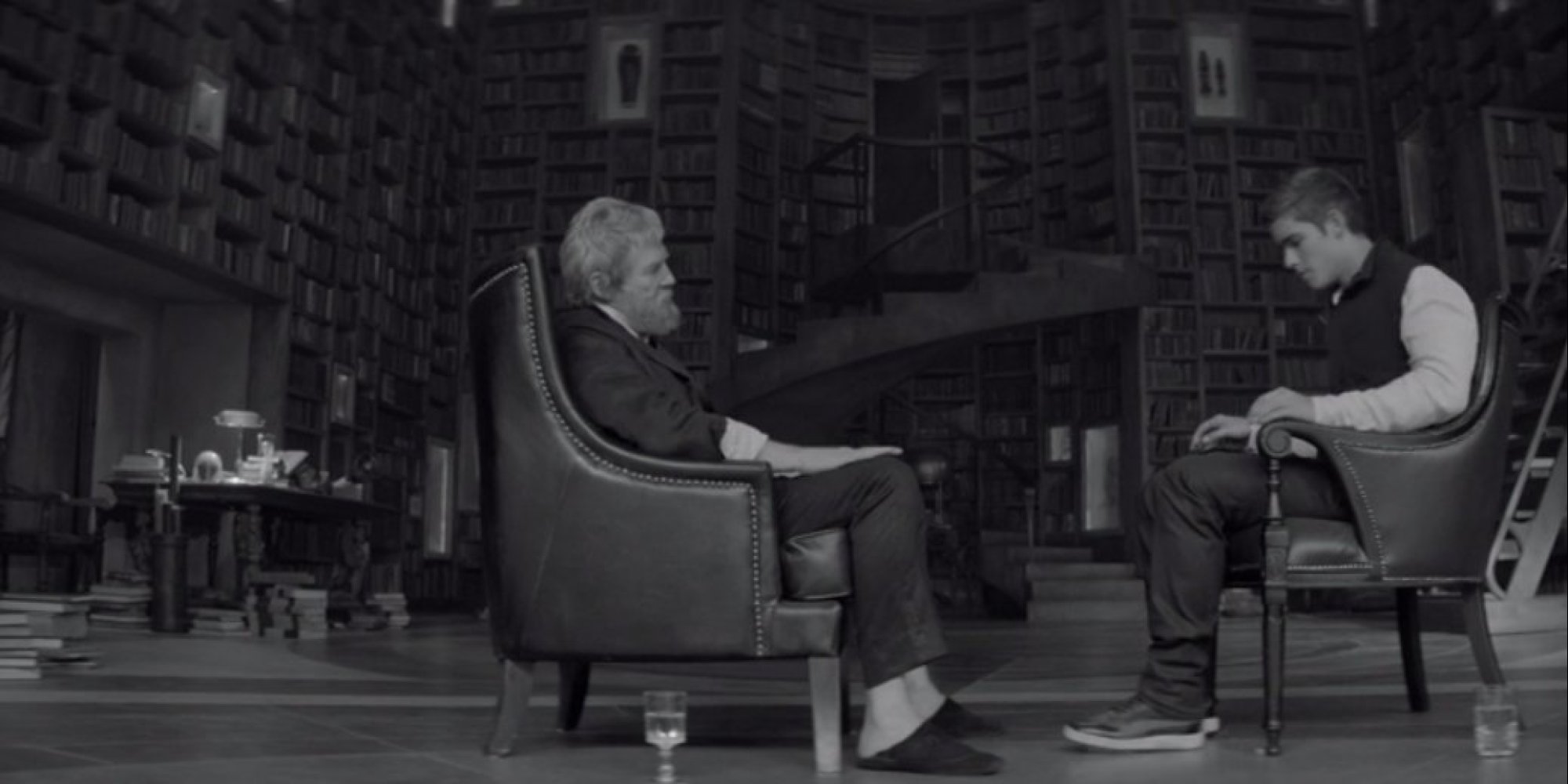
Oh yeah. This clearly looks normal. This CAN'T be symbolism!


Personally, this is something I love about The Giver. We live at a time where people use movies to substitute for reading. Or where people rely upon films to visualize stories. Sometimes it can be hard to argue with them that the best way to experience the visual aspect of a story isn’t through visual media. To me, The Giver is potent proof that the power of a reader’s imagination is even greater than the power of film.

Wednesday, September 17, 2014

Writerly News: Why you wish you were taking Seriated Speculative Fiction

It's been a bit longer than I'd hoped between blog posts, mostly due to technical difficulties.

I own a laptop, (I call it Critter) that is mighty in soul but not in body. Critter's actual computer-y components work fine. It's just exceptionally fragile and prone to crumbling. When I first received Critter, it got so excited it's hinges started bursting apart. With some creativity and a few coats of glue, we've managed to weather a few years without any major incidents, but the end of this summer proved to be the time when Critter threw in the towel. Once again, the inner computer worked fine, but the metal that joins the power cord and the inner computer decided to break and pop out after I did a whole lot of nothing to it.

Luckily, the laptop doctors managed to fix Critter up and Critter has since returned home, slathered in a fresh coat of glue (seriously. There is additional glue on my computer. Along with replacing the part that broke, they generously squirted more glue on Critter) and humming away happy as ever.

This all happened just in time for my Twitter account to malfunction and lock itself up for several weeks. So while I could finally write again, I had limited options for alerting people of blog updates. Mercifully, the account is back to normal again. So I now have a healthy computer and a healthy connection to the my interwebs "presence" (such as it is).

At the same time, the usual September business engulfed me as I moved to a new job and, even more importantly, into the final semester of course work for my Masters degree! It feels very exciting and I've worked towards this for a long time. So hurray. :)

As my writing life is once again being dictated by course work, I thought it might be fun to switch up some of my posts to reflect what I'm working on, especially since my final classes are SO COOL!!!

Due to the fact that I am currently working with my school by distance, my final course is something of a self-directed study. It's half literature/readings course and half writing/workshop seminar and since I'm the only student, its somewhat tailored to my interests.

So what is this mystery class? (Other than fabulous, of course)

I have proudly and pretentiously titled it: Seriated Speculative Fiction

But what does that MEAN?? Well, to those uninitiated in the jargon of University Creative Writing, "seriated" means "something that comes in a series" and "speculative fiction" is basically code for "science-fiction and fantasy, but we're calling it something else because SERIOUS writers keep making fun of us for writing science-fiction and fantasy."

This is a pretty special kind of course to do. Most of the time in English literature courses, there are a lot of confines on what you do and don't have time for. I took a class in my first semester on English novels that prominently feature manor houses and use them as a thematic element. Yes, that sounds really specific, but there was still plenty that was being left out by the course. The novels were dense and we only had time for five. Also, it turns out a LOT of people have written novels about crumbling English manors. When you think about it in those terms, it's easy to see that I could have done a whole course on just Charles Dickens featuring manor houses as a strong thematic element. But of course, in order to do the topic justice, our teacher chose breadth and we read five different authors, just one book by each.

Last year I studied Young Adult literature, which was a fantastic course, but there the subject matter was even broader. We plowed through over a dozen novels for this course, but again, there was only time for one book by each author. This meant, for instance, that when we were covering the topic of science fiction and dystopia, our professor had us read The Hunger Games but neither of the books that followed. Frankly, it's difficult to make time for a series within a class, unless you're studying the work of a single, specific author. (Example: I took a course on August Wilson, one of Pittsburgh's favorite sons, and we read his entire Pittsburgh Century Cycle. But unless you're a two time Pulitzer winning playwrite, like Wilson, it's unlikely you'll get to read every work by a single author.)

But as a science fiction and fantasy writer, the topic of the "series" is a highly relevant topic for someone like me. Certainly there are stand alone novels within these genres, but a large number of the most "important" works within sci-fi and fantasy are series. With authors creating whole new worlds, isn't it natural to use those worlds for as many stories as possible? The pattern is obvious as early as The Lord of the Rings or The Chronicles of Narnia and not much has changed since.

On top of that, in my first year in my program, I wrote a sci-fi/fantasy novel, which I then had to put on the back burner so that I could finish my thesis the following year. But I'd confided to my thesis director that I did have ideas for a second book in the same series and she's been looking for an excuse to teach a course like this - one that focuses on how a series builds over time rather than as stand alone novels.

And so here I am! Studying the coolest thing ever and writing some of my own *ahem* seriated speculative fiction on the side. I'll be reading three full series for the course, each published relatively recently and each aimed at a different age group. And as I finish each, I plan on posting a few of my thoughts about the series as a whole and what can be learned from them. So for those reading along, the series are as follows!

As my middle grade series, I will be studying The Giver Quartet by Lois Lowry

Because reading it for YA lit clearly wasn't enough, my YA series will be The Hunger Games Trilogy by Suzanne Collins

And ending the year, I will tackle the adulty adultness of The MaddAddam Trilogy by Margaret Atwood

I just finished up The Giver, so expect a follow up post to this one coming soon! Until then, happy seriated speculative fiction to all!