
Um...
Well...
The first one is about a thief, but that was probably self-explanatory. And I already mentioned the Greece/Turkey thing. Other than that? Weeeeeelllllll........
 |
| Seriously though, great book. |
While it's something I love and respect about her writing now, this almost killed the series for me in the second book. The first is still my favorite, and I went into book two expecting something similar. But they weren't the same types of stories. I almost didn't read the third, but my best friend was so insistent that the third one was wonderful, I eventually gave in. I'm glad I did, because (again) the third was nothing like the second OR first, but at least I liked it and at this point, knew better than to expect consistency.
Now don't get me wrong; you still need to read them in order for the story to come together fully. And there are common elements between them, like the general setting and an emphasis on story-telling and mythology. But between the drawn out release schedule (book five was released last year, twenty-one years after the first book came out) and the lack of a status quo, I get why this series never blew up in the public conscience the way Harry Potter did a year later. Frankly, it's hard to pitch a series that doesn't stick to it's own rules.
Harry Potter and the Mystery of the Magical Thingy
Quick question: What are the Harry Potter books about?
Almost anyone can list the basic components off the top of their heads: Boy wizard attends magic school, makes friends and goes on adventures trying to solve what wacky hijinks Voldemort has in store for this edition!
In addition to the basic premise pitched above, here are a few other stalwarts that showed up in every (or almost every) Harry Potter book:
- a new spell/magical object, which would be key to solving the book's central mystery
- a new Defense Against the Dark Arts teacher
- Quidditch matches
- a pivotal scene at Christmas time
- a conversation with Dumbledore at the end of the book
- Hogwarts itself figures almost like a character
- most scenes written in third person, limited point of view, from Harry's perspective
- thoroughly described British food
- Harry, Ron and Hermione operating as a trio, despite their differences
 |
| A Deathly Hallow, given at Christmas. I know what I'm talking about, man! |
The book that strayed the most from this formula was, of course, the final one, Harry Potter and the Deathly Hallows. I mentioned in my ranking of the seven Harry Potter books that I think the books lost something by abandoning Hogwarts, but I know plenty of people who feel differently. Part of me agrees. Rowling spent a long time at Hogwarts and was clearly sick of writing Quidditch and frankly, Quidditch matches would have seemed so superfluous in the final installment, I'm glad she didn't hem too strictly to her previous models. Overall, while Deathly Hallows might be missing some of the fun and magic of earlier books, the changes feel justified.
But there are still a remarkable number of ways Deathly Hallows doesn't rock the boat. The central heroes don't change. The final battle still is at Hogwarts. The quality of British food has gone down in the camping sequences. There's an emotional Christmas at Godric's Hollow. And not even death can stop Dumbledore from giving an end of book pep-talk to Harry.
Arguably, the Harry Potter books are rather stagnant sequel to sequel, but I'd argue that's one of their strengths. They changed just enough each time, but never the core of what people enjoyed. Rowling wisely built into her model things we could expect to change book to book - new teachers, new spells - so that she could get away with adding new material that didn't feel as though it broke the rules of the previously established world/books.
The best series establish a status quo readers want to return to, but build some flexibility into their structure to allow for innovation. You read Redwall because you want adorable mice defending an abbey full of food, but the evil abbey attackers of the week can change. You read The Hunger Games because you want to see Katniss fire some arrows and stress over boys, but her allies and who dies in the arena can change.
Assuming a series starts on a strong foot, the problems creep in when the creators don't seem to know what elements can safely change and what can't. It's all very well to say that a "flexible status quo" is important, but how do you pick out the elements readers want to see again and again and what is ripe for rewriting? Sadly, this is one of those areas that's probably easier to learn from by examining failures than those that did get the balance right.
Fantastic Beasts and Where on Earth is This Going?
 |
| D'awwwwwwwwwwww |
Woof, these movies.
Since the second movie is newly out, I'll try not to spoil too much, but be warned. There are criticisms ahead.
I want to love them. I do love aspects of them, particularly Newt Scamander himself, who is a darling cinnamon roll of a human being. Over two films, there are some real strengths and some real weaknesses. Bothering me at this present moment, is one central concern: this series does not know what it's about.
The first film started out well. I'm not a purist, so the idea of more films exploring the same world appealed to me. I didn't much care when they had to rewrite some of Newt and Dumbledore's history, so as to allow for the new world and stories to exist. Most of those details hemmed the world in such that it would have made for boring movies. Early writing by Rowling portrayed Newt as a low-level ministry worker who gradually rose through the ranks by doing exceptional work and never rocking the boat. That character is markedly less interesting than the "new" Newt.
More importantly, the first film seemed to strike the balance "right" when it came to sequels and choosing what to change and what not to. Because this movie was taking place in a new time period, with a new cast of characters, most fans I spoke to were willing to give the movies a chance. They weren't messing too hard with beloved characters, like the original power trio. Superficially, they were starting over. But just because these movies aren't about Harry Potter doesn't mean they aren't sequels. Realistically, they're still being marketed to the same demographic who read and loved Potter, and so long as that's the target audience, certain expectations are going to come into play.
So what are those expectations? And how well do the Fantastic Beast movies follow along with them?
The first movie featured a couple key ways they matched the original Potterverse. One, the first movie was still a mystery about a particular magical element, in this case, Obscurials. There were ways the mystery format felt a bit weaker, with the villain actually doing more of the investigating than Newt himself, but from the first scenes of a giant shadowy thing ripping up New York, we knew what the central mystery was.
Second, much of the appeal of the Harry Potter books came from fun characters who loved each other, running around together, trying to solve problems. The first movie mostly succeeded here too. Watching BFFs Jacob and Newt go on adventures, and gradually pick up Queenie and Tina was a hoot. I wish Tina got a chance to act out an emotion other than "worried" more often, but hey. The rest of the cast was great, and I didn't dislike her, so it was a solid start. In fact, of everyone in the second film, Tina wins the award for "most improved." It turns out, she does have something beyond resting-worried face to offer the world.
 |
| Even when flirting, so very very worried. |
Third, elaborate world building. While Hogwarts is far more iconic than 1920s New York, or any of the locations used in the sequel, other aspects off the world design really have paid off in both films. The original Fantastic Beasts was actually the first film in the entire series to win an Oscar, because the design team was freed up a bit, and they really knocked it out of the park on costuming.
Visually, the sparkle is still there in the second film. But aside from a better version of Tina, categories one and two took major hits in the sequel. The plot suffers from a syndrome where everything is explained at the eleventh hour, in the final act, and up until then, it feels like characters are just running around, communicating poorly for the sake of maintaining "tension." What this means is that what the central mystery is doesn't become clear until the very moment it's solved. Or possibly never. YouTube is littered with videos right now "explaining" that "crazy ending" in the second movie because, unfortunately, it needs either an encyclopedic knowledge of previous Potter material to follow along, or someone who has that knowledge to excitedly wave their arms at you and talk you through for an hour after the film. (For those in need of services, I charge a reasonable fee for my Harry Potter frantic arm waving)
Second, they botched the friend group dynamic way too soon. Some might rightly point out that the Harry Potter books weren't afraid to let the characters fight and have drama. But there was still a status quo they got back to by the end of each book. Come end of term, Ron and Hermione were no longer sniping at each other and Harry was no longer morosely avoiding one of them. Their friendship was always a power they could rely on when things got bad. Even when she was frozen by a basilisk, Hermione still gave the boys the final clue to defeat Voldemort. In the interest of going "darker," the second movie denied us the entire dynamic that made the first movie and every Harry Potter book fun. And that sucks.
What follows is an incoherent, messy plot where you're not sure who you're rooting for and you can't tell why you're being led into each scene. And why does the camera keep cutting away right before newcomer Lita Lestrange can just SAY what the deal is? Poor Lita. A few more minutes screen time, and this whole movie could have fallen into place an hour earlier.
Fantastic Beasts: The Crimes of Breaking Viewer Expectations
The second film briefly returns to Hogwarts, where Dumbledore is teaching Defense Against the Dark Arts. I loved all the scenes that took us back to the place I fell in love with as a child. I couldn't help thinking, "man... I wish we were watching the movie taking place here."
You could sense what the story going on in the background was about. McClaggen coming to Dumbeldore's defense brought back wiffs of Harry himself. Lita Lestrange, misunderstood Slytherin girl with a weakness for gentle Hufflepuff boys, spoke to the odd-duck friendships we loved in the original. The first series knew what it was about, and when these films echo that sense of purpose, they're at their best. Unfortunately, they aren't willing to embrace the past.
The warning signs were there from the beginning. Those involved with making the films said years ago that the second would be very different from the first. They made good on that promise, but likely went too different too soon.
Right now, as I try to find the essential qualities of the franchise, my list is an abbreviated mess of both good and bad qualities, none of which I feel certain will last until the next movie. The friend group didn't, so what else is up for grabs? If I had to guess, based on the first two films, here is my recipe for what stays consistent in a Fantastic Beasts movie:
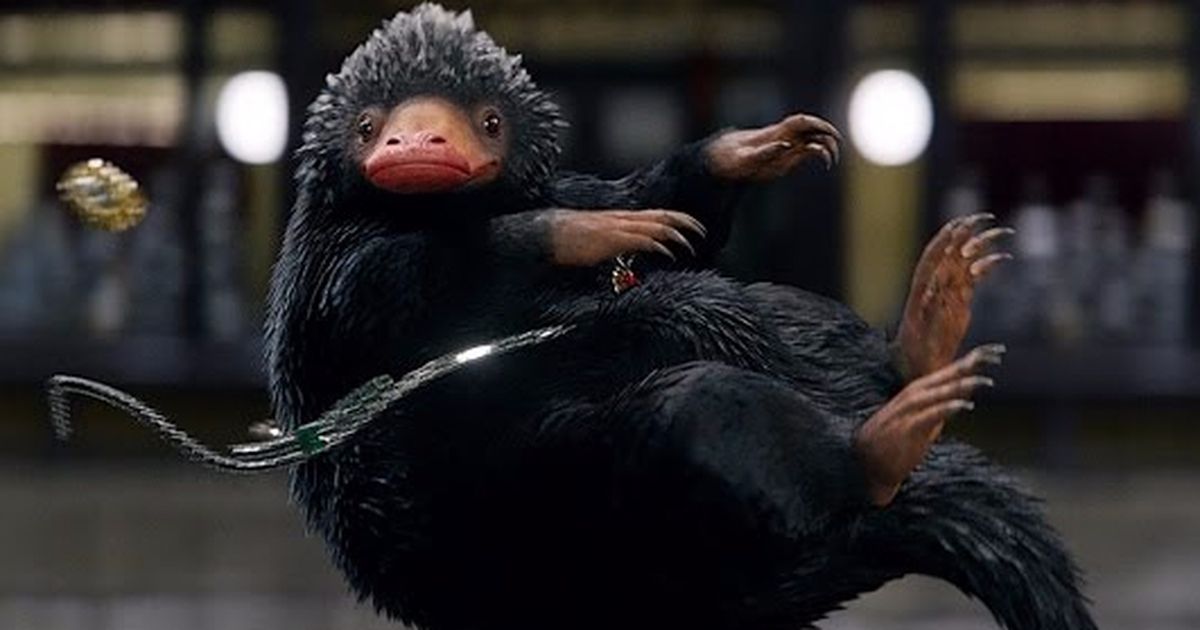 |
| A most important movie element |
- Newt Scamander introduces us to a new dangerous animal, that is secretly very sweet. This will always be the best scene in the movie.
- Nifflers!
- Let's visit a new swanky city in the 1920s! Hurray for costumes!
- Newt runs around town in a sequence of not very plot-centric adventures
- Tina is worried.
- Grindlewald is the villain... he's a completely different kind of villain between two movies, but he's still the villain.
- There is a central mystery but who - if anyone - is solving it is even more mysterious.
- Everything is navy blue and probably taking place in an alley, where silhouettes converse
- One of Newt's beasts helps save the day.
I really hope that last one remains true. By far, the most compelling aspect of the series is that Newt sees humanity in the inhuman. He and his creatures are underestimated, but he knows how to use them to get the upper hand.
If the series doesn't end with an acromantula eating Gridlewald, I'll be very disappointed.

