For a long time, I did a lot of guilt over books that I didn't finish. I think this reaction came from the way books are presented at school, where it is a mortal sin to leave books unfinished, no matter how much you dislike them. You get bad marks for that kind of thing.
As a result, leaving books unfinished left a stale taste in my mouth, one that drove me to such guilt that, yes, I often balked at reading for fear I would be stuck with a book I didn't like, but HAD to finish. It was a little like never loving for fear of heartbreak.
After starting my MFA, I think my feelings have shifted quite a lot. First, let me say that I have read more books that I've disliked or even hated, in the last two years than at any other point in my life. But I've also been exposed to some new favorites I never would have known to try otherwise. When you're studying literature, for every Howard's End there will also be a The Chocolate War assigned to you. (Yes, I hated one of those books) That's just the subjective nature of reading.
Obviously, I had to finish the books I loathed, but all the same, I've found my perspective shifting around the topic of leaving other books unfinished. During the summers, I am much more likely to get a few chapters into a novel and then ditch it. Permanently. I do this for a few reasons, upon which I shall expound.
1) I will read enough books I don't like during the school year to more than likely make my quota.
This might sound snarky, but I mean it truthfully. There IS a lot of use to occasionally reading books I don't like. From those books, I learn what I don't want to do in my own writing. They force me to work the part of my brain that wants to "fix" plot problems, pacing or word choice. That's a useful muscle for me to use. Also, these books will usually still have some strong elements, and those can be worth learning from. All the same, I think I learn more from reading books that I DO connect with - the ones I want to emulate. The bulk of my time should go into reading those. Even in the summer, time is limited, so I don't waste it on filling the "bad book quota."
2) If I'm not occasionally tossing aside a book I don't like, it means I'm not reading widely enough.
As a child, I went through phases where all I ever read was Brian Jacques's Redwall series or Rowling's Harry Potter. I knew I would like these books and I wasn't wrong. In general, I can usually bet that if a book is a Young Adult or Middle Grade Fantasy or stars animals, I will probably like it. Sure there are exceptions, but these are safe choices.
But reading shouldn't always be safe. It should challenge us emotionally and intellectually and often that is best done with books outside our comfort zones. Last summer I made an effort to read more YA contemporary, not really my area or my "thing." One book I hurled across the room at chapter 5, but another was John Corey Whaley's Where Things Come Back and that made me sob happy tears. It stretched me as a reader and as a writer. Reading deeply and widely is an important part of developing a voice. But outside my usual genres, I know I'll also find more things I don't click with. There's a reason that I love animal and fantasy books and a reason why I write them. Some books will be good enough to transcend those barriers of personal preference. Others will be returned to the library early amid rants of disappointment.
3) Just as you can learn a lot from a bad book, you can learn a lot from an unfinished book.
Last year, I read one book that wasn't bad or outside my genre and it... lost me. The pacing dragged and I just couldn't be bothered with finishing it. That was when the importance of editing for length in an adventure story REALLY hit me. At over 120,000 words, this book had too much bogging down the story. I had a hard time imagining it ever picking up to a satisfactory clip and so eventually I returned it to the library. As a long winded author, it was a hard lesson to learn. Other books I've put down because their openings were confusing or contrived or uninteresting. Others lost me with an uneven middle or bothersome content choices. All valuable lessons.
But the number one reason I don't finish books is...
4) The library thought they owned the thing or something.
Seriously, guys. My library does this ALL THE TIME. They let me take away a book but then they seem to think they still own it or something and start sending emails asking for it back. But in all seriousness, this is an interesting category. Sometimes these books are the ones that show the difference between a 4 or a 5 star book in my rankings. No matter how little time I have, I will always finish a 5 star, even if that means facing late fees. A 4? Well, I may check it out again. I may not. Generally, it's yet another reminder of how subjective this whole reading business is.
So those are MY reasons for leaving books unfinished. What about the rest of you? Any others?

Writerly thoughts from writerly writer, Emily Paxman.
Tuesday, July 29, 2014

Thursday, July 10, 2014
Book Reviews: Ship Breaker

Whew! So time for another book review. Despite the quiet on the blog, I've been reading a lot and doing a ton of writing lately. Actually, the silence on the blog is probably RELATED. More on that some other time.
For now, let's take a look at Ship Breaker by Paolo Bacigalupi.
Nailer works in the cesspool that is Bright Sands Beach, a ship breaking yard where old oil rigs are broken down for spare parts and whatever scavenge is left on them. The polar ice caps have melted and most major cities lie drowned, leaving the world in a panicked, resource deficient state.
Nailer himself is little more than a statistic - a skinny kid who can still just fit inside the ducts of old ships where he cuts off lengths of copper wiring in order to make quota. But when a luxury clipper washes up on Bright Sands Beach during a storm, opportunity arrives, both in the wealth on board and in the swank girl who owns the boat. Opportunity that could prove to be just as deadly as it is lucrative.
What Makes it So Good:
Ship Breaker has been on my radar for a long time, as it's one of the few Science Fiction Novels to win the Printz Award. For those who haven't heard of the Printz, it's kind of like the Carnegie or Newbery Awards, only for Young Adult literature as opposed to the Middle Grade books that the other awards tend to focus on.
Like a lot of award committees, those in charge of the Printz tends to favor fiction placed in a contemporary setting, but luckily, that favoritism is't as rigid in children's literature, of which YA is still considered a part, as it is in Adult Lit where book genres are kept separated and in different sections of your local bookstore. So sci-fi and fantasy get a slightly better shot at being recognized for their contribution to the wider scope of literature. Naturally, I was curious about this post-apocalyptic tale (a genre often portrayed as tired and over done in YA today) that got the Printz voters all a titter. It seemed like a book that would have to fight one heck of an uphill battle in order to get recognition.
Really, I think what it boils down to is that that the text is beautiful and lyrical. The world Nailer inhabits is grim and potentially overwhelming with its violence and despair, but Bacigalupi has a tremendous command of language, which he uses to shape the mood of the book. Executed poorly, this book could have been a slogging, muddy wallow, but even at its darkest moments, something about the way the landscape and Nailer's emotions are described keeps a rim of hope surrounding the story.
The pacing is also quick and satisfying. There's a good balance between Nailer's reflections and the high stakes adventure the book sells itself on. The world is also interesting and well executed. Many of the post-apocalypse tropes one might expect from knowing the genre are in play, but they're well done and have twists that make them interesting. For example, Ship Breaker's take on humans mixed with dog DNA made me wish The Hunger Games could have been so successful when they used the same idea at the end of the first book in the trilogy. I was much more afraid of Tool the Half-Man than I ever was of the dogs chasing Katniss and Tool isn't even a villain. The characters were enjoyable too, Nailer in particular. He's the right blend of sweet and tough, something a story like this needed in order to stay balanced.
What Might Make it Better:
"Sounds like your basic D.I.D. Damsel in Distress." - Phil, from Disney's Hercules
This is a rescue the damsel book, 100% plain and simple. While the book has great characters, atmosphere and world building, it could have used a more interesting plot.
Nothing really complicates this rescue story either. From the moment Nita arrives, you know she can't be responsible for her own salvation, because THAT would impact Nailer's ability to prove himself. All you're left guessing at is whether or not Nailer will be successful in saving Nita, because Rule-of-Fiction dictates that she can't do it on her own. Nita herself isn't a bad character, she just isn't able to be interesting because that would interfere with Nailer's growth. Her use to the story as a plot-trinket is too great to let her be a character that controls her own fate.
Now let me be clear that I am not opposed to all "rescue the damsel" scenarios, but I think many of the ones that do that story well complicate it some way. Take Princess Leia, for example. At the beginning of the first Star Wars film, Leia transfers the plans to the Death Star into R2-D2 and effectively turns R2 into the plot-trinket necessary for advancing the rebel cause. R2 becomes the target of numerous "save the droid" moments in the movie and the object of pursuit by the empire. Leia's rescue is a reckless after thought, and for Han, the decision to save her is entirely driven by greed. She also plays a more formative role in their escape, blasting open a path into the trash compactor and alerting them that the empire must be following them when their escape is easy because, once again, it is R2 and the plans on him that are the empire's target, not her. Once at the rebel base, she takes a leadership role independent of Han and Luke and for the rest of the series, she's never rendered totally helpless again.
Star Wars is not often a good example of how to tell stories with compelling female characters. Ship Breaker is certainly miles ahead as far as its diversity of well-rounded female characters, so I'm not criticizing the book on it's ability to portray an interesting female character. The issue is that standard issue "rescue the princess" scenarios don't make for interesting plots. They're too well known and force other characters to perform predictable, specific actions within the narrative.
Comparing to The Hunger Games again, here would be the place where Hunger Games edges out Ship Breaker. Peeta certainly gets his chances to be a man-sel in distress, but the plot is about other things too. It's about winning the games. It's about sticking it to the Capital. It's about putting on a good show so that they can get sponsors. And those other goals, coincidentally, often conflict with each other. Ship Breaker's side plots are never at such compelling odds with each other. True, Nailer's choices aren't easy, but they're not as suicidally hard as Katniss's either.
Despite these critiques, however, Ship Breaker is a fantastic, lovely book, and a reminder that plot isn't often about originality, but about execution. The book is beautifully executed and well worth a read. I wouldn't review it if I didn't like it. Just... ya know... don't expect too many surprises in the plotting department.
Wednesday, February 12, 2014
Writing News: First Pages and Blind Speed Dating!
When I started this
blog, I wondered how long it would be before I had “news worthy news” and
(spoiler alert) I am pleased to say that I do today! Today’s entry comes
courtesy of the age old practice of querying, the bane of every would-be author’s
existence. First, a quick background story, for context:
Last year in August, I
started the first semester of my Masters of Fine Arts at Chatham University in
Pittsburgh, Pennsylvania. Moving all the way to the Eastern US was a pretty big
deal for me and I was anxious to make the most of my time there. I left with
big plans to finish writing a children’s book I’d started, one about goblins
and faeries and other delightful staples of high fantasy.
Only I got there and
at the first class, my new thesis advisor informed me that the five pages due the
next week had to be, no ifs ands or buts about it, from a new project. Mildly
frustrated, I spat out a piece that was a jumbled mess of characters. I’d had
these people in my head for some time, but no firm structure to build them
into. So, since I was homesick, I had them find something strange on a Pacific
North-west inspired beach and then called it a day.
But when I took it to
class, something strange happened. Our class was on beginnings and as my
advisor explained what made a good beginning, I got really excited. Because I
knew my sample pages began horribly. They started exactly in the wrong place,
had too many characters and didn’t get to the meat of the scene fast enough. I’d
never been so thrilled to be mediocre.
So I revised the pages
and brought them in and they were... better. Good enough that I felt inspired
and I just kept plugging away. In the end, I never returned to that first
children’s story, though I hope to some day. By the end of the following summer,
I’d finished a draft of RIFT RUNNERS and started querying my spankin’ new YA
novel in the fall.
Which brings me back
to the beginning pages. Querying really is the art of making a good first
impression. There’s the letter itself, of course, but there’s also those key
first five pages. Many literary agents
request that they be included with the query, while others who later request
pages may stop reading early if the first few aren’t up to snuff.
Needless to
say, I’ve had “first page” anxiety for a long time. I have a higher request rate from agents on queries that DON'T offer any pages to look at and both the partials I've sent out I got rejections on. It might be too soon to say if the opening pages suck, but it has got me wondering. I’ve rewritten the first
chapter of my novel more than any other part of the book. Much to my surprise,
it isn’t endings that turned out to be hard for me, but getting the opening to
click with the rest of the story.
Which brings me to the
Blind Speed Dating contest, hosted at Cupid's Literary Connection. This is effectively a query letter contest, the first of its kind I’d ever
stumbled across and the idea got me excited. It turns out there are lots of
contests like this hosted by bloggers, most of whom communicate through
Twitter. They seem to be a pretty tight knit, supportive community.
In this case, a pack
of 40-45 entries would be chosen from the submissions and those would go into a
round where agents would bid on the chance to see pages. But not only would
your query be judged, so would your first 250 words. In other words, if I
applied to this competition, I might get some idea of how my query and first
page stack up next to the other YA entries, publically. So entered I did.
I came to the
conclusion that if I didn’t make it past the bouncer round and into the pot the
agents look at, I would be tearing up the first five pages AGAIN and truth be
told, I may still do that. But it’s happily in the category of *may* still
because I DID get in!
This isn’t to say my
first page is perfect, but if I do rewrite it, it will structurally be a very
different opener. And I frankly don’t know if it will be any better. In editing, we all hit points where it gets hard to see the forest for
the trees. Changing the beginning may be better for the story. It may not. So
here’s to one more exciting week of testing out Rift Runners! Hopefully, an
agent or two might pierce it with their cupid’s arrow. J
Thursday, January 30, 2014
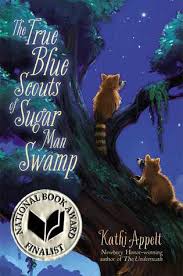
The True Blue Scouts of Sugar Man Swamp - Book Reviews
A Texan Bayou, a pair of young raccoons, a world famous gator wrestler, the legendary Sugar Man himself and a whole mess of wild hogs running your way. If that doesn't get you excited, well then, brothers and sisters, I don't know what will.
Available on Amazon
What makes it so good:
Kathi Appelt's novels came across my line of vision as I started prepping for my thesis. My own project is a Middle Grade novel about domestic cats, which also happens to feature a raccoon as a supporting character. Well, this novel is sort of an inversion of that. Its primary heroes are a pair of raccoon brothers - brave Bingo and fastidious J'miah - and among the supporting cast is a domesticated cat, the often ignored Sweetums. But here the similarities start to fall away, which I am very glad of, since I would hate to have to live up to this novel by tredding the same path!
Yes, it is that good. Scouts is delightful start to finish and Kathi Appelt's novels are a masterclass in "what literary middle grade fiction looks like." Her work is oozing with voice and personality. In the case of Scouts, this comes in the form of an omnicient narrator that bounces back and forth between the many disperate story threads. At one moment the narrator might be following the efforts of Bingo and J'miah to wake the Sugar Man and the next, it will be detailing the dastardly exploits of the greedy land developer who wants to turn the swamp into a gator wrestling park.
But the whole story is tied together by that one narrator, whoever it is. The story is told like an old American Tall Tale, the kind you might hear on an old fashioned radio show. This isn't a book that addresses it's "readers." It's got "sports fans" and "mothers and fathers." To say the least, I was sold on the book the moment I got to the end of the first chapter and read this:
"Every denizen of the swamp knew that the wrath of the Sugar Man was something to avoid.
He also had a rattlesnake pet, Gertrude.
Crotalus horridus GIGANTICUS (also known as CHG).
Brothers and sisters, the stakes were high."
To say the least, the book demands to be read aloud and I've heard the audiobook is fantastic. If you do read it aloud, don't be surprised if you find yourself accidently speaking in your best approximation of a Southern Accent. You can just feel your old grandpappy telling you this story on his back porch.
On top of that, the action is fun and exciting, the characters are charming and memorable and the ending is oh so satisfying. This book is very worthy of the pile of awards being heaped on its head.
What might make it better:
If those looping, twisting plot threads sound confusing, then rest assured, Appelt takes the time to catch her readers up. In the end, it's actually pretty straight forward. Indeed, most criticisms I've seen of the book were that it can get repetitive. Take the story of the wild hogs, for instance. Numerous times the narration bounces back to the hog family, all running towards Sugar Man Swamp, hoping to get a mouthful of the famous, delicious cane brake sugar. And honestly, the action never changes much in the scenes involving them. Every time you see the pigs they are still running towards that same swamp chapter after chapter. Each one of those chapters really do read about the same.
Now, this personally didn't bother me. I thought the hogs were hilarious and they added another layer of personality and comedy to the book. But I can see where repetitive scenes and descriptions like these might not work for some readers. I think whether or not this becomes a problem for you depends on how much you connect with the voice. I was there 100%, but for someone less keen, there are quite a few moments that don't exactly move the plot along.
Really, these asides reminded me of watching a stand-up comedian whose gone off on a thread away from his main joke. If you think he's great, you will watch him ramble and be perfectly happy. It might even be where some of your favourite parts of his sketch are. But those who are less sold, I think, find themselves wondering when he's going to make his flippin' point.
Books often have those moments too. How long we're willing to let the plot be derailed is often a function of how much we like the way the story is being told. If we love the world the author has created - through voice, setting, character, you name it - we'll have more patience waiting for the plot to take over again.
For a good example of this in action in another book (or series, as the case may be) I submit the Harry Potter series. There's a noticable switch around book 4 where the books about doubled in length. Previously, Harry's adventures had to be tight and generally focused on the over all plot. The first three books don't have very many wasted moments and remain pretty tightly focused on the over all action of the story. But by book 4 that changed. Rowling was famous and her fans wanted to remain in Harry's world as long as humanly possible. They wanted every detail of the lives of Harry and his friends. Here, again, Rowling had a fantastic voice (hers came more through world building and character, rather than a quirky narrator) that readers just wanted more and more of. So the trips to Hogsmead got longer, the Yule Ball got grander and the supporting cast grew and grew. If the later books aren't as tight as the first ones (they aren't), it's because we asked for it.
So returning to The True Blue Scouts of Sugar Man Swamp, maybe read the sample chapters on Amazon, and if you find yourself smiling at that folksy voice, get your hands on a copy. You will love it. If you think it's only okay, get your hands on a copy anyway. You'll probably still like it, just not think it's the best thing since sliced bread. No one seems to really dislike this books. It's more a matter of whether you adore it or not.
What makes it so good:
Kathi Appelt's novels came across my line of vision as I started prepping for my thesis. My own project is a Middle Grade novel about domestic cats, which also happens to feature a raccoon as a supporting character. Well, this novel is sort of an inversion of that. Its primary heroes are a pair of raccoon brothers - brave Bingo and fastidious J'miah - and among the supporting cast is a domesticated cat, the often ignored Sweetums. But here the similarities start to fall away, which I am very glad of, since I would hate to have to live up to this novel by tredding the same path!
Yes, it is that good. Scouts is delightful start to finish and Kathi Appelt's novels are a masterclass in "what literary middle grade fiction looks like." Her work is oozing with voice and personality. In the case of Scouts, this comes in the form of an omnicient narrator that bounces back and forth between the many disperate story threads. At one moment the narrator might be following the efforts of Bingo and J'miah to wake the Sugar Man and the next, it will be detailing the dastardly exploits of the greedy land developer who wants to turn the swamp into a gator wrestling park.
But the whole story is tied together by that one narrator, whoever it is. The story is told like an old American Tall Tale, the kind you might hear on an old fashioned radio show. This isn't a book that addresses it's "readers." It's got "sports fans" and "mothers and fathers." To say the least, I was sold on the book the moment I got to the end of the first chapter and read this:
"Every denizen of the swamp knew that the wrath of the Sugar Man was something to avoid.
He also had a rattlesnake pet, Gertrude.
Crotalus horridus GIGANTICUS (also known as CHG).
Brothers and sisters, the stakes were high."
To say the least, the book demands to be read aloud and I've heard the audiobook is fantastic. If you do read it aloud, don't be surprised if you find yourself accidently speaking in your best approximation of a Southern Accent. You can just feel your old grandpappy telling you this story on his back porch.
On top of that, the action is fun and exciting, the characters are charming and memorable and the ending is oh so satisfying. This book is very worthy of the pile of awards being heaped on its head.
What might make it better:
If those looping, twisting plot threads sound confusing, then rest assured, Appelt takes the time to catch her readers up. In the end, it's actually pretty straight forward. Indeed, most criticisms I've seen of the book were that it can get repetitive. Take the story of the wild hogs, for instance. Numerous times the narration bounces back to the hog family, all running towards Sugar Man Swamp, hoping to get a mouthful of the famous, delicious cane brake sugar. And honestly, the action never changes much in the scenes involving them. Every time you see the pigs they are still running towards that same swamp chapter after chapter. Each one of those chapters really do read about the same.
Now, this personally didn't bother me. I thought the hogs were hilarious and they added another layer of personality and comedy to the book. But I can see where repetitive scenes and descriptions like these might not work for some readers. I think whether or not this becomes a problem for you depends on how much you connect with the voice. I was there 100%, but for someone less keen, there are quite a few moments that don't exactly move the plot along.
Really, these asides reminded me of watching a stand-up comedian whose gone off on a thread away from his main joke. If you think he's great, you will watch him ramble and be perfectly happy. It might even be where some of your favourite parts of his sketch are. But those who are less sold, I think, find themselves wondering when he's going to make his flippin' point.
Books often have those moments too. How long we're willing to let the plot be derailed is often a function of how much we like the way the story is being told. If we love the world the author has created - through voice, setting, character, you name it - we'll have more patience waiting for the plot to take over again.
For a good example of this in action in another book (or series, as the case may be) I submit the Harry Potter series. There's a noticable switch around book 4 where the books about doubled in length. Previously, Harry's adventures had to be tight and generally focused on the over all plot. The first three books don't have very many wasted moments and remain pretty tightly focused on the over all action of the story. But by book 4 that changed. Rowling was famous and her fans wanted to remain in Harry's world as long as humanly possible. They wanted every detail of the lives of Harry and his friends. Here, again, Rowling had a fantastic voice (hers came more through world building and character, rather than a quirky narrator) that readers just wanted more and more of. So the trips to Hogsmead got longer, the Yule Ball got grander and the supporting cast grew and grew. If the later books aren't as tight as the first ones (they aren't), it's because we asked for it.
So returning to The True Blue Scouts of Sugar Man Swamp, maybe read the sample chapters on Amazon, and if you find yourself smiling at that folksy voice, get your hands on a copy. You will love it. If you think it's only okay, get your hands on a copy anyway. You'll probably still like it, just not think it's the best thing since sliced bread. No one seems to really dislike this books. It's more a matter of whether you adore it or not.
Post the First
For a long time I've been very passionate about books, stories and everything affiliated with them and frankly, I love to talk about all of them! Writing, reading, you name it.
Maybe I'm slow on the uptake, but it kind of finally came to me that a blog might be a good place to have a conversation about books. I know, SUPER novel idea there. But anyone who wants to participate in this "book related conversation" can feel free to do so. I've got a few ideas for how I want to get this ball rolling.
So what types of posts can you expect to see here? Well! You may see...
1) Book Reviews!
Right now I am finishing up my Masters of Fine Arts in Creative Writing and I'm specializing in writing for children and young adults. To say the least, that means I'm reading a lot while I finish up my thesis. I'm going to say right away that I don't so much plan on reviewing books that I don't like. I'd rather endorse the ones I do. That being said, no book is perfect. I hope to dissect both what makes a great story work and also what can be done to improve one. Once in a while, I may also review movies and apply the same academic rigour that goes into anything I just want to nerd out over.
2) Topical Editorials!
As mentioned, I'm finishing my Masters right now, plus I am in the process of querying my first novel. As such, I have a LOT of thoughts on a LOT of things when it comes to the craft of writing, university writing programs, querying agents and relying on cats for emotional support. Expect occasional discussions of literary tropes and tools of the trade. And rambling discourses on plot mechanics. Oh mercy, plot mechanics.
3) Writerly News!
So - let's be honest - just about EVERYTHING a writer does in life can often be spin doctored so it seems to be about writing. For instance: I own three cats and am currently writing a novel about cats. So in theory, I could just post about how my Siamese overgrooms herself. But I'll try not to do that. Look for news regarding my thesis, conferences I attend (I'm hoping to get to AWP in February!) and, of course, the ongoing slog of getting a first novel published. Hopefully this last goal won't end in depression and dejection, but hey! Even that makes a decent story. :)
Finally, expect to hear about my garden. And my cats.
Maybe I'm slow on the uptake, but it kind of finally came to me that a blog might be a good place to have a conversation about books. I know, SUPER novel idea there. But anyone who wants to participate in this "book related conversation" can feel free to do so. I've got a few ideas for how I want to get this ball rolling.
So what types of posts can you expect to see here? Well! You may see...
1) Book Reviews!
Right now I am finishing up my Masters of Fine Arts in Creative Writing and I'm specializing in writing for children and young adults. To say the least, that means I'm reading a lot while I finish up my thesis. I'm going to say right away that I don't so much plan on reviewing books that I don't like. I'd rather endorse the ones I do. That being said, no book is perfect. I hope to dissect both what makes a great story work and also what can be done to improve one. Once in a while, I may also review movies and apply the same academic rigour that goes into anything I just want to nerd out over.
2) Topical Editorials!
As mentioned, I'm finishing my Masters right now, plus I am in the process of querying my first novel. As such, I have a LOT of thoughts on a LOT of things when it comes to the craft of writing, university writing programs, querying agents and relying on cats for emotional support. Expect occasional discussions of literary tropes and tools of the trade. And rambling discourses on plot mechanics. Oh mercy, plot mechanics.
3) Writerly News!
So - let's be honest - just about EVERYTHING a writer does in life can often be spin doctored so it seems to be about writing. For instance: I own three cats and am currently writing a novel about cats. So in theory, I could just post about how my Siamese overgrooms herself. But I'll try not to do that. Look for news regarding my thesis, conferences I attend (I'm hoping to get to AWP in February!) and, of course, the ongoing slog of getting a first novel published. Hopefully this last goal won't end in depression and dejection, but hey! Even that makes a decent story. :)
Finally, expect to hear about my garden. And my cats.
Subscribe to:
Posts (Atom)