Monday, July 4, 2016

SILK SONG: A New Story By Emily Paxman

NEWS NEWS NEWS NEWS NEWS!!!!

So you might have noticed I have news.

The short version of the announcement is that I've finally decided to share some of my own, original fiction with you through my blog - or blogs as the case now happens to be. You can find the new story, called Silk Song, right here! The long version has a few more details.

Blogging and the World of Self-Publishing

For a while now, some of you lovely people who read my blog have asked if you can read some of my REAL writing. You know, that stuff I talk about all the time. In particular, people have wondered why I don't post more fiction on this blog.

There are a few reasons for that, the chief being that anything posted on the internet is - for all intents and purposes - published. It might not be on a bookshelf and it might not be making me any money, but regardless, if it's online and searchable, it's published. And on the whole, my goals have been to get my fiction published more formally with actual presses who can help me distribute, promote and make money off it.

Most people can understand these concerns, so the follow up question tends to be something along the lines of: what about short stories? Wouldn't those work well on a blog? And wouldn't those be easy? There's kind of an assumption that short story writing is easier than novels and so if I published a short story here, it wouldn't be as much of a sacrifice. And on top of that, it might even be worth something to me if I can use free stories to grow my audience, so that there are people interested in my full length novels when they do come out.

I can't say if I agree with these sentiments or not. Back in my Master's program, I certainly had friends who found short story writing easier than novels and a few of them did publish work for little or no pay. But even in these cases, they were typically publishing their short form work with literary magazines - both in print and online - which provides both legitimacy and increased visibility to the work. So it's not as if the people I know who produce good quality short stories are simply blogging those willy-nilly. They place them carefully and use them to build their own careers, which may be commercial fiction or may be more closely tied to academia.

But the more important objection to posting short stories on this blog is this: I don't write them. It's not for any terribly complicated or idealistic reason. I just don't get ideas for them. During my undergrad writing classes, I struggled to come up with pieces short enough to satisfy my professors. I find it much easier to structure a novel than a short story, not because novels are easy, but because they work better for me and the ideas I have.

In fact, the only short form ideas I get tend to be for... essays. Which you'll notice are what I write for this blog.

Beyond Emily's Stories

I've kept this blog for a couple of years now. It's a small, cozy space where I get to talk about stories and why I love them and where, to my delight, I get to hear from all of you too. I started this blog hoping to spark conversations with my friends and strangers about the books I love. And believe me, it's been a joy to do it. When someone asks me what sort of books I think boys might enjoy or when I find out that one of the books I reviewed has become a new favorite for someone, I'm so touched. And the fact that people are now asking to see more of my work is incredibly exciting.

For a while, I've wondered if I couldn't do something more here. I've had an idea for a new project involving my blog since September, but I was hesitant to put it into action. I knew it would be a large undertaking, and before I committed myself to it, I wanted to make sure I was consistently posting at least once every month, preferably a little more. Since then, I've made an effort to be more diligent and I've also branched out in terms of topics I cover. It's been wonderful to be more involved here, and so I finally feel ready to start my next big project...

Introducing Silk Song

When I considered posting my work on-line, I knew it needed to be the right sort of story and in a way that worked for me. These were my main concerns when I considered posting fiction:

1) I don't get short story ideas. It would need to be a novel (in some sense).
2) My favorite thing about blogging is the interaction and conversation with my readers. I didn't want to post something just to get "likes" or "dislikes" on it. That's not very interesting to me.
3) It needed to be something that I could throw my passion behind and that represented my honest work and effort. And yet still somehow be something I didn't feel so proprietary of and attached to that I wanted to save it and try getting it traditionally published.
4) It needed to be fun.

With these things in mind, I began planning SILK SONG. In some ways, it will be very representative of what I write. It's a Young Adult fantasy novel about a girl who must survive exciting things. It will be posted in short chapter/scene length installments on it's own blog. I considered placing it here, but I felt that since it's an independent story, it needed room to breathe. I didn't want the story's feed clogged up with my book reviews and ramblings about the Hunger Games and I didn't want this blog to lose its focus on the more academic side of writing.

But most importantly, it will also be highly interactive!

SILK SONG is what I like to call a vote-your-own-adventure novel. At the end of each installment, readers will be given a chance to vote on what happens next, from a list of options I provide. Whichever option garners the most support, that's the path the story goes down! I'll write it into the next section and let you see the consequences of your decisions! In addition, I will be reading whatever comments people make, so if I *happen* to like a suggestion you've made for the story in the comments, hey! You never know. It might turn up later.

You can always find a link to SILK SONG from the menu at the top of this blog, as well as right here. The first chapter is already posted, so feel free to dive in! If you want more details about the story, explore the story's blog, which has an "about" section and "FAQ" already. For those who are curious, my current definition of "Frequent" for "FAQ" is "my roommate mentioned this when I pitched the idea to her." Thank you, Miranda.

I'm really hopeful you'll all enjoy the new project. If you do, please share it with your friends, especially if they are/are parents of teen-agers. And if you're liking it yourself, you can subscribe to the blog so that your email lets you know when a new installment is up. Your support means a tremendous amount to me and let's face it, the poll will be more fun with more people voting in it.

Once again, thank you for reading and following along with me. And I hope to see you all over at SILK SONG. It's gonna be awesome, guys. I can feel it. :)

Tuesday, May 24, 2016

When is it safe to ignore criticism of your writing/art?

Hey everyone! In my last post I talked about my excitement for the LDStorymakers Conference in Provo, Utah, and promised that I would eventually blog some of my thoughts and feelings about the experience.

First off, it was AMAZING!!! I had a fantastic time, met awesome people and made great connections. The classes were phenomenal and as I embark on revising my manuscript, I've been doing it with one eye on the notes I took from a few of my favorite workshops.

But of course, not every happy story is without it's hiccups, and oddly enough, one of the WORST experiences of the conference was also one of the most informative. It really made me reflect on my work in a different way and reevaluate what I believed about receiving feedback. And that's the first story I want to share from the conference, mostly because I think it will be interesting to other people.

As a side note, I almost didn't post about this, because I don't want to seem crabby or ungrateful or to suggest that my general experience was anything other than awesome. I've worked through all the emotions that came from this long ago, and can happily stick my thumb sky high, a la Siskel and Ebert, when I sign off about this story. But I am sharing this, because the thought keeps reoccurring that what I learned might benefit someone else.

The First Chapter Contest

Leading up to LDStorymakers, I entered a First Chapter Contest with - you'll never guess - the first chapter of my most recent manuscript. Before I submitted it, I participated with a group of other writers attending the conference, trading manuscripts and offering feedback. It was fantastic! My work improved hugely thanks to their input, and I started making friends, some of which I met in at the conference.

During this process, I received amazingly positive feedback. A number of people told me they loved my work, some even going so far as to say it was the best of everything they'd critiqued for the contest. I was getting such consistently good reviews, I couldn't help going to Provo somewhat hopeful. I knew my category - Young Adult Sci-Fi and Fantasy - would be a tough field, due to it's popularity, but with such an outpouring of affection, it didn't seem unreasonable to think I might win something.

I didn't win anything.

Okay, well... that was fine. Of course I was disappointed, but this had always been a possibility. At least I would find out how close I came. One of the great things about this contest was that every entrant received feedback from four judges. The judges would all be writers in that area who were either agented or published, so that sounded pretty legit.

As one of my dear friends said, maybe I was *just* below placing and they could tell me how to improve. But as my wounded pride grasped for some straw to hold to after losing, I said, "yeah. Or maybe I got three really good reviews and one who didn't understand my work and marked me down so low, I couldn't place."

Guess which one it was?

If you were thinking this was the post where Emily is forced to swallow some humble pie then, HA! That is not this post! You may refer to the post where I talk about my sister not wanting to eat scrambled eggs for that!

As it turned out, I was bang on. I got three very, very high scores and the other? Not so much. To put the numbers in perspective, imagine submitting an assignment at school and getting three A+ grades and one C from four separate teachers. Those were my marks. In a school setting, you would appeal that C and probably get it thrown out. But this was a contest with over 300 entrants and not the sort of thing where appeal boards are set up. The arts don't work that way. If you don't win, you don't win. End of story.

So what do you do with a critique like this? What do you do with critique generally? Let's see if we can unpack some of the dos and don'ts of listening to feedback.

1) Don't Bother with Opinions that come from People who Don't Care about your Work

I think it should go without saying that anyone who attacks creative work or laughs at it or ridicules it or generally points out flaws so that they can make themselves feel better is not someone you should be listening to. No mean-spirited critique is helpful. Also beware of those who describe themselves as "brutally honest." While not universal, most people who describe themselves that way emphasize the "brutal" part more than anything else.

Frankly, I don't believe the truth is inherently brutal. We're talking about creative work here, not nuclear war. There is nothing someone can say to you about your work that can't be stated kindly.

One of the main criticisms I've heard levied at MFA programs is that students become competitive and critiques start turning into attacks. I'm so grateful for the teachers I had who chased away the notion that we were directly competing with each other, because I can admit that it WAS tempting to see things that way. But many of my classmates were creating work so vastly different from mine, it would have been foolish to treat them as direct competition. My classmate who wanted to write about psychedelic drugs was not going to chase my Middle Grade novel about cats out of the market.

So be kind and be helpful. You can afford to be. And even when you are dealing with people within your genre, competing for the same attention, still be kind. You never know when you're going to need those people to help you by blogging about your book release. Like most professional environments, the writing world gets smaller the deeper you get into it.

In return, look for helpful, insightful critique that has your best interests at heart. If someone seems intent on tearing you down, don't listen to them.

That being said, critique often feels inherently cutting, so do beware that just because something HAS hurt your feelings doesn't mean that the person who said it MEANT for it to hurt your feelings. If you find yourself wounded by a critique, try asking them to clarify what they are saying or how you could make it stronger. Sometimes that prompts the kinder, healthier response as they start looking for solutions rather than problems. Ask about how you can improve your work. It also helps you by making you focus on forward progress rather than what might be "wrong" with the project.

Of course, if they follow up these measured, even questions with something rude then by all means, roll your eyes and move on. This is easier said than done. It can be very VERY hard to share your work with the world and any rejection can feel damning. But you'll only get better by listening to people who look at art with an eye towards making it better.

2) Subjectivity is a Thing

So as mentioned above, the arts are unfair. They're inherently subjective and sometimes you draw the short end of the stick. And because the arts are ALSO underfunded, you can't exactly beat your chest demanding a more *fair* result. People do the best they can with the resources they have and the people who run contests of any kind wrack themselves with guilt already over the dreams they may  be crushing.

I've participated in a large number of contests over the past few years - some I've placed in, others I haven't - and I've seen the hosts struggle to massage the egos of disappointed writers as we slump back to our writer-caves. Much of the time, they repeat over and over how subjective art is and how, in another context, our work might be loved.

But in actuality, I've rarely found this comforting. Usually when I've missed out on something, I've been able to explain it somehow, either through feedback or through where I perceive there to be a weakness still. Hard as it is for authors who are starting out to hear, most of the time, you miss out because you ARE missing something, even if that something is small. At least, that's been my experience. Which kind of undercuts this bullet point, but leads us to the next...

3) Always Evaluate Criticism Carefully

It is much easier to write something good than it is to write something that is perfect. I actually tend to pick apart the work I like MORE than the work I don't, because I see better where the piece could go. This is one reason why finding people who like your work to give you feedback can be really important. These are the people who feel a vested interest in making your work better.

But isn't it shortsighted to only listen to people who like your work? Why yes, dear reader, it is! Especially if you evaluate how much someone likes your work by how many nice things they have to say about it. If you have a good relationship with your critique partners, you'll listen when they say "this is crap" or "I don't understand this" or "wanna go get a burger?" (This last bit of advice is extremely important!)

But there are other sources (besides your friends/critique partners) that you should turn to for feedback whenever possible. You should also listen to the Important Strangers. Who are Important Strangers? They are people with some sense of authority in your area who have a vested interest in making your work better.

So for example, I once had an agent write back on a query letter that she liked my manuscript's concept, but thought I used too much dialogue. Or there was the time one of my professors pointed out that "he shrugged his shoulders" can ALWAYS be shortened to "he shrugged" since no one is going to be confused and think someone is shrugging their eyebrows. This feedback is incredibly valuable, as it comes from a higher vantage point than yours. As such, if anything, it should be taken MORE seriously.

And this is why I had a hard time, initially, putting that bad review down. The feedback I got WAS from an Important Stranger and I was used to listening to them. The contest was anonymous, so there's no reason to think this person hated me or didn't want me to succeed. More likely, they just didn't like my work or think it up to snuff, and felt they should give an honest critique for the sake of the contest. There certainly wasn't anything mean-spirited about the comments.

At first, I tried to reconcile the reviews by thinking, "well, maybe this reader is more deeply bothered by my story's flaws. Maybe if I fixed those flaws, then my work would be ACTUALLY perfect!" So I read over the review carefully. But when I lined it up next to the others, I began to realize a disconcerting pattern.

Reviews 1-3: I loved the opening! So brooding and atmospheric! So evocative! I was right there with your characters! The soldiers and caving-in ceiling gave it immediate tension!

Review 4: Boring opening. A leaky ceiling is not interesting.

Reviews 1-3: The style was so gorgeous. You are clearly a gifted writer. The language was so evocative.

Review 4: I don't think this writer knew what the words they were using meant.

Reviews 1-3: I would definitely read on, though I've got a few concerns that need addressing when you edit this. I hope you get this published! It's going to be great!

Review 4: I would not read on. This is not publishable yet. Needs a lot more work.

Clearly reviewer 4 didn't like my chapter. But often the things they were hitting me the hardest for were the things my other readers loved, like my word choice and my opening. And changing those things in order to satisfy that fourth opinion would have essentially meant making my book something it wasn't ever supposed to be.

I wanted evocative language that built tension slowly. This story was about quiet dread, not flashy explosions, so yes, the leak in the roof came first. And three of my Important Strangers understood that and loved my work for it. One didn't.

At various intervals, I've posted about my experiences disliking books or finding ones I hate so much I don't finish them. Some have been classics, and a small part of my brain might even understand why. But at the same time, I do not get the appeal of The Chocolate War and if it showed up in a contest folder for my review, I would probably give it bad marks. If I didn't know it was a classic, I might assume everyone else was busily giving it bad marks too.

4) In Publishing, Nothing is Sacred. Be Ready to Make Painful Changes... Usually

What I relate this all for is to say very strongly that it is not advisable to change your work substantially until you have MORE THAN ONE opinion on it. Even if that opinion comes from an Important Stranger. Of course, if you do have only one review, but that review resonates with you and you DO want to change it right away, that's another matter. But if their words are coming somewhat as a shock, wait for another opinion.

Again, from personal experience, I can say that if something needs to be fixed, you will get enough feedback from trusted sources to confirm that they are right. Querying my first manuscript, I learned that I needed to rethink the way I balanced scene and description. I needed to be more ruthless when deleting "extra" words. I started the book in the wrong place.

I hated rewriting my first book. But when I finished, I was so glad that I did. While that book still isn't perfect, I could see how much better it had become. But in order to get there, I had to be willing to delete scenes and characters I loved. I had to gut large sections of text. I had to reevaluate praise I got in school, because the publishing world didn't respond the same way as my teachers and classmates. I had to admit that some of the "artistic choices" I'd made were the wrong choices.

When I looked at those first chapter critiques, I knew that I'd made an artistic choice with my manuscript, and that choice had lost me at least one reader. But I also realized that for the sake of the project, it was a reader I could live without.  My reviewer assured me that if they found my book on a library or store shelf, they would not turn the pages past Chapter One. And that's okay. I didn't write it for them.

I didn't think I'd come away from that contest with this kind of story. I hoped for a more traditional happy one. But if nothing else, that critique taught me something I hadn't realized I'd only partially believed - that it was okay to disagree with someone who disliked my work. There are situations where it's appropriate to nod, say "that's your opinion" and then get on with life. At the end of the day, it's not worth writing a book unless you love it. There are far easier ways to make money than publishing fiction.

Oddly enough, that bad review only made me more confident in my love for my story. I could firmly say that there were things I wanted that book to be, no matter what someone else said. And that feels pretty darn good.

Friday, April 29, 2016

Conferences and Drafting: Writerly News

You might have noticed it's been a little while since I wrote a blog post. Or you might be going merrily along with your life none the wiser. Either option is fine. But suppose you ARE that person who has noticed it's been a while. Suppose you've been waiting for me to complete my blog series on boys and reading. If you are among these people, then you might have worried the past month or so that I wasn't writing much any more.

Well, worry no more! Because as it turns out, the problem was the opposite. I was writing. A lot. And it all pointed towards one purpose...

Conferencing

Last year I completed my Master's, and while that was awesome and exciting, it also left an empty space in my life. During my studies, I'd been enjoying the support of a school writing community that pushed me to produce large amounts of work and also to refine that work into something better. I can't emphasize enough how amazing it was to focus entirely on writing during that time.

But perhaps even more important, school created a sense of urgency in me when it came to writing. If you didn't show up with new pages every week, you looked like you were slacking off, even if you were technically *allowed* to miss a week or two. But why would you want to? The feedback we got by workshopping our stories each week was incredible. All you had to do was finish on time, and people would read your work and comment on it and help you improve it.

Deadlines were one of the best things about school. I could take or leave the grading, but the chance to learn and workshop once every week - well, I can't over state it. Since graduating, it's been difficult at times to force myself to keep to a writing schedule, largely because I don't have someone external to me expecting results in a timely manner. I tried setting my own deadlines, but I felt strongly that I'd do better if I was writing for something.

The best solution I could come up with was to look for a writing conference I could attend at some point this year. Conferences provide a great opportunity to network with other writers, enter contests, interact with publishing professionals and - highly appealing - join critique groups and get feedback on work.

I spent a long time finding a conference that I both wanted to attend and could afford to get to. Eventually, I settled on LDStorymakers. There were agents and writers in attendance I was interested in hearing speak, an impressive schedule of classes and, perhaps most compelling, it was all taking place in Provo, Utah, where I could stay at my sister's house for free!

I've already thoroughly enjoyed getting to know the Storymakers community. People have been supportive and reached out to one another, offering feedback for the First Chapter Contest and playing Twitter games with each other. It only seems like it can get better from here.

I'm also excited - though, honestly, nervous too - about the chance I'll have to interact with other writers who are members of the Church of Jesus Christ of Latter-Day Saints. For anyone who was either raised in/currently belongs to a religious community, it's pretty much impossible for your faith not to influence all aspects of your life. I think this is particularly true for Mormons and other minority religions. We're used to coming off as oddballs to other people at times, because our beliefs aren't common and we might not see things the same way as those who hold more mainstream beliefs. And despite this obvious influence, my writing life and my religion have often been kept in neat, separate boxes.

While I was at school, I was hyper aware of how weird I may or may not seem to people, due to my faith. I'd grown up as a decidedly uncool nerd, and away at Grad School, I got my first taste of acceptance by the wider population. We were all a bit weird, and it was so exciting to be around people who shared that experience and the accompanying enthusiasm for art. But even there, I was still DIFFERENT different. I couldn't go to bars or clubs and, as a result, missed out on some of the wider university culture.

My friends at Chatham were warm, accepting and never challenged me to do anything that went against my beliefs. Any barriers that existed between my faith and how I expressed myself were largely of my own making. My friends all knew I was Mormon and we had a lot of awesome conversations about faith and what religious beliefs we'd grown up with. But when we got into the actual classroom, I had a tendency to shut down that side of me. It was easier to come across as something neutral and non-threatening than to expose that more vulnerable part of me. We come from a culture where "common knowledge" suggests that religion is a topic that makes people angry and uncomfortable, so even when I was experiencing acceptance, it was hard for me to shut down this script in my head, that if I spoke about my writing from a position of faith, I would be yelled at or labeled as narrow-minded.

I don't know if I would have even noticed I was doing this if it hadn't been for a student/teacher mid-term talk I had with one of my favorite professors. He was trying to encourage me to be freer in my work, and I wasn't getting what he meant. As his careful, professional words failed to get through to me, he looked me squarely in the eye and said, "you're Mormon. You believe God put you on this earth for a purpose. That's what you need to write about."

I was instantly in tears, struggling to express how grateful I was to him for saying that. This fundamental part of why I write and why stories matter to me was something I'd never dared express in class. In my head, it would only make me sound crazy. But deep inside, I knew he was right. I didn't tell stories for fun, but because I believed they were part of what I was supposed to do with my time on earth - something I felt accountable to God for.

It's a memory that still makes me cry. In many ways, there are three things that matter to me in my life. My faith, my family and my writing. Inside me, they're all deeply intertwined, but it's rare I get the chance to experience them as united. I don't expect every Mormon author I meet to experience their faith and writing the same way I do, but that's part of what's exciting about the chance to go to LDStorymakers. I'm curious how others have integrated these things in their life and their work. Some will be people who write directly for the LDS niche market. Others will be like me, influenced thematically, but more drawn to books and stories aimed at a wider audience.

Hopefully, all of us can learn from each other. The conference starts on Thursday, May 5th with an intensive workshop, and I'm super excited! And one of the main reasons I'm excited is because I'm bringing a brand, spankin' new manuscript with me.

Drafting

Earlier tonight, I finished drafting my current Work-In-Progress (or WIP as we writerly types like to call it), a Young Adult fantasy novel set in a world based loosely on pre-revolution France. It's about the transition of a country from war to a state of peace and the uneasy tensions that still litter the countryside. And at the center of it is a young woman who's thought of as a traitor by both sides.

Doesn't that sound exciting? I'm so glad that story exists now. And I would likely still be dragging my feet drafting it if not for the fact that Storymakers is starting this coming week.

Remember that talk about deadlines? Well, I promised myself that when I went to Storymakers, I would focus on classes that could help me edit my manuscript. But in order for that to be relevant, I needed to be finished the book I planned on editing. It is rough rough rough, my friends, but it exists. I love this story, and I'm really looking forward to going over it again and reshaping it into the story it is in my head, if not yet on the page.

Later, I might write another post talking about the differences between drafting and editing. For now though, I'm planning on focusing on the conference. I plan on writing at least one more post on LDStorymakers after it's finished. Maybe even more than that. :) We shall see!

Until then, I also want to say thank you to everyone who supported me while I finished this story. A huge thanks to my friends who were very understanding when I had to blow them off so that I could write. Thanks to my brother, who not only was patient with me through this process, but also has let me write about him and our relationship in the most bizarre, twisted of manners. Thank you to my sister who - did I mention? - is letting me stay at her house FOR FREE! Major props to Disturbed, whose cover of Simon and Garfunkle's Sound of Silence literally got me through a few of the darker chapters. A colossal thank you to my dad, who volunteered to drive me to the conference so he could see his grandsons and because he loves me a crazy amount. And a "I couldn't have done it without you" to my best buddy, Miranda Leavitt, who listened to long, rambling talks about characters, plot twists and my neurosis. She's a super hero, and I couldn't be more thrilled that she's coming to the conference too.

And above all, an amazing, all encompassing THANK YOU to my mother, who put up with a flaky daughter who constantly forgot to clean things and instead of getting annoyed with me, would time and again tell me to go finish my book instead. She's even volunteered to do my laundry tomorrow so I can focus on my other conference prep activities, because she's a saint.

For the rest of tonight, I'm gonna celebrate and rock out to the Dolly Parton album iTunes had on sale tonight. It's a good day, folks. A very good day.

Friday, March 11, 2016

Boys Vs Books: Beating Back against Busy

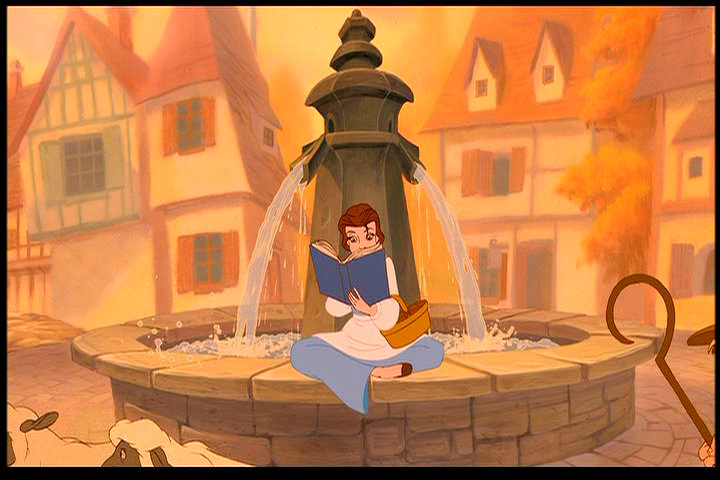
Last week, I started a new post series centered around the problems facing boys in regards to literacy. I framed the initial discussion around Disney's Beauty and the Beast and how reading is portrayed within that movie. The movie is famous for its positive portrayal of Belle as a modern, forward thinking princess, and that portrayal is driven home through her love of books. But while Belle is constantly shown reading, the men around her all have problematic relationships with books.

If you're interested in reading the earlier discussion, you can find the previous posts in this series here:

1. Boys vs Books: A Tale as Old as Time

Today, we're looking at one of the three male characters Belle attempts to share her love of books with. We'll start with the first man we see her talk to, the town baker.


Going on Dates with the Baker

When Belle attempts to tell the baker about reading Jack and the Beanstalk, he quickly dismisses her and moves on to his business concerns. The baguettes aren't going to sell themselves, and clearly, he's in a hurry.

As a writer, books come up frequently when I talk to people. It's almost impossible for them NOT to come up, since "what do you do?" is one of the most common questions we ask each other in today's culture. This is especially true on dates. The guys I go out with often feel pressured to fess up to how much they read. And I'll admit, I can understand why. It doesn't help that one of my favorite conversation topics IS books, but I try to make the topic more accessible. I ask them about what they liked to read as kids, especially since children's lit is my area. But invariably, they still tell me how much they currently read, and the conversation typically goes like this:

"I like reading, but it's been forever since I, you know... read a book. I'm just so busy. It takes way too much time."

I'll note that this happens often when I talk to women, too. Busy is one of the great catch phrases of our time. We're all too busy for SOMETHING, it's just a matter of exactly WHAT we're too busy for. But formal studies and my own casual experience reinforce that yes, there are more men who are too busy to read than women.  So why is this?

Mastering the Reading "Economy"

Many of my male friends have pointed out that time is a big stumbling block for them. A few have described to me at length that the reason they like movies so much is because they're self contained and over quickly. A movie costs you 2 hours of your life, whereas a book of 80,000 words is going to take you at least 4 hours. But this still doesn't answer the question of why men read less. Aren't the same time constraints applicable to women? What made men particularly susceptible to cutting books out of their lives based on time?

For an incredibly unscientific perspective on this, I would like to share an anecdote. It comes from ONE man articulating his feelings about reading, but they struck me as rather interesting, and worth restating. Call it my inner anthropologist, but while these first hand accounts don't always have statistics to back them up, I find they can add depth to cultural trends.

We were, at the time, talking about my frustration with the fact that none of my male friends seemed to read books that had come out since the Harry Potter series ended. While I'm now paraphrasing, in effect, he said this:

"Look, books take a long time to read. And men can't help but look at things like books and movies and say to themselves, "what is this going to get me long term?" We're trained to think of practically everything like a business investment. We find ourselves wondering "how much social capital is this going to result in?" So if we are going to read, we read the classics, because we know 40 years from now, there's still going to be people talking about them. They'll have paid off. With things we're less sure on, we're more likely to just see the movie. It makes it so we know what people are talking about, but haven't invested our time in the wrong place. I know for myself, I can't help worrying that if I read a new book, no one is going to know what I'm talking about. I want to read things I KNOW someone else has read and assured me is valuable."

This surprised me a bit. What he was describing wasn't reading for the pleasure of reading, but reading for some other, distant benefit that would result from the experience. Often, when we try to sell people of either gender on the idea of reading, we sell it on the idea of enjoyment. We repost pictures of people curled up in pajamas with a cup of tea and a novel on Facebook. We talk about falling in love with characters and getting the "feels" when tragic things happen to them.

This looks super exciting to me, but is it everyone's week-end fantasy?

The problem with this model is that when we stake reading entirely on enjoyment, it becomes as low priority as everything else we happen to "enjoy," rather than distinctly different and valuable. When we tell people to read more because "reading is fun," the discussion can become us shouting at them "YOU SHOULD LIKE THIS MORE" and them shouting back either, "but I don't..." or "I DO like it! But have you noticed how little time there is for the things I LIKE?"

Both counter arguments are quite strong from this standpoint. You can't force someone to like something and you can't force them to have time for things they like when life is so busy, busy, busy!

But still, why is this happening with men? Is it because of the "business model" mentality my friend described to me? Studies suggest that men show this "investment" thinking in other areas. Women dominate in college majors such as the arts and humanities, whereas men dominate in areas that lead to firm "career paths." And yes, this includes many specifically "business" related programs, like finance. Some estimates place women as only 40% of business majors, despite the fact that women are outstripping men in general college enrollment. Where women do show up in business is in the more people oriented areas like human resources and advertising, which, it's little surprise, are also areas that depend more on reading and literacy skills.

The Unbeatable Value of Reading

Once again, we've got a cultural problem on our hands. There's a lot of buzz about getting more women into STEM fields, and gradually, we're making headway. Girls are catching up in mathematics and other STEM related subjects in schools. But at the same time, boys are falling further and further behind in literacy and reading. And it's getting serious enough, that I wouldn't be at all surprised if studies surface showing that it's leading to decreased opportunities in earning and employment, just as the disconnect between STEM and girls has for women. We already know boys are falling behind in college enrollments, and reading and writing are their roughest subjects.

No amount of movie watching will substitute for the skills developed during reading and writing. Better readers are better writers and reading and writing skills are fundamental in many employment fields. Of my two degrees, it's by far my writing degree that actually gets me jobs. Offices are looking for people who can research, read and write.

On top of that, most employers want people with strong social skills, and some studies have suggested that there is a link between reading literary fiction and the ability to empathize with others. Reading books where the characters showcase complicated emotions has been linked with our ability to deal with these emotions when real people showcase them. While the studies are still early, they are compelling. Also, even if you're someone who works in a contained sphere where social skills aren't paramount, empathy is a highly valuable skill when it comes to things like - oh, I don't know - making friends and dating, perhaps?

At the same time, high levels of watching television (and we can lump movies in here largely too) are associated with higher levels of depression, something that can't be said of reading. In other words, you might THINK you like movies more, but they're not actually making you very happy. At least not in the long term.

Books are all about teaching the value of long term investment and commitment. They require us to visualize what the words say, rather than spoon-feeding the images and experience to us. They take effort and time and, like most things that require effort, make us think harder and deeper and ultimately, make us happier.

All of this is to say that if you are someone who thinks you are too "busy" to read, I hope you'll reconsider what you're investing in. A single book might take more time than a movie, but you will be better for it if you add a couple books to your diet. The benefits are not equal. The long term gains from reading outpace the long term gains from movies and television.

I know I'm coming down hard here, and don't get me wrong, I love a good story told through film. But if the average American spends 4.5 hours watching television, is it really fair to say that none of that time could be spent reading? In an ideal world, I'd love to see people cutting that back so they could fit in 1 hour of reading per day, but if people even tried to read just 2 or 3 new books each year, that would be a huge win.

The Busy Boy

Up until this point, I've spoken largely about how adult men interact with books. But the truth is, men aren't the only one's saying they are "too busy." Studies in Ontario have shown that this is an excuse that school age boys give too, where frankly, it holds less weight. While a grown man might conceivably be busy with a career or caring for children or any number of adult responsibilities, children are not busy in the same way. And yet, I'm guessing that it's pretty frequent that boys who are too "busy" to read as children often grow up to use the same excuse as adults.

I can think of three things that boys might secretly be saying when they claim they're too busy to read.

1) I'm one of those textbook over-scheduled children who literally can't find time to read. I'm so busy!
2) I don't like reading very much and I'm busy doing other things!
3) Some other reason is stopping me from reading, but I'm too embarrassed to talk about it, so I'll just say I'm busy and hopefully, that means you'll leave me alone.

What are the solutions for dealing with these reasons?  Let's give it a shot, shall we? Of course, if you happen to be the parent of a girl who makes these same excuses, the same advice applies.

1) The Over-Scheduled Boy

Of all the potential problems, this is probably the easiest dealt with. Most of the time, these HUGE schedules are determined, at least in part, by parents. Simply ease up the schedule and slip in time for reading! Encourage it as something important and set aside time for it. Read to them. One thing that often helps is giving kids only two options when it's time for bed - turn the light off and fall asleep, or read for half an hour before you have to turn the light off and fall asleep. Most kids find sleeping more boring than reading, and this can become prized time for a child where their only option is to develop a love of reading.

2) The "Busy" boy who can't be Bothered.

Let's talk about the word "busy" again. Up until this point, we've been assuming a certain definition for it. In the earlier discussion, "busy" meant "I have too many things to do and this is not a priority, so I'm not doing it" but when we talk about children - especially very young children - busy often means something else.

My youngest nephew just turned two-years-old and he's at that age where he is curious about everything, into everything, climbing everything, falling off everything and altogether, never seems to stop moving. In an effort not to problematize this behavior, parents and early childhood development specialists often refer to this behavior as "busy." He's a busy little boy. This descriptor is sometimes applied to girls, but more often, it falls to boys. "Busy" ends up a code word for energy and an inability to sit still.

Whether or not boys are innately worse at sitting still or if this is a quality that's culturally determined is HUGELY up for debate and well beyond the scope of this essay. I'm not qualified to comment on whether or not boys are encouraged or allowed to run amok more frequently than girls or if their innate drive to zip around with endless energy is tied into a different genetic make-up. Regardless, our perceptions of their busy wiggles do play into how we parent little boys.

A recent study conducted in Canada, the US and the UK found that subconsciously, parents read more to their girls than their boys. At least one of the reasons why is because it's seen as more difficult to read to boys and get them to sit still for a nice, calm parental reading session. This disparity has been linked to why it is that girls are entering schools already ahead of boys in reading and literacy skills. By the second grade, boys begin describing reading as a "girl" activity, dissociating themselves further from it. But the younger you go, the more interest boys show in books and reading. They just aren't crazy about sitting still for it.

One thing that is worth noting with any of these studies regarding academic achievement is that the ability differences are always greater AMONG boys and AMONG girls than BETWEEN boys and girls. What I take this to mean, in part, is that the disparity BETWEEN genders is not inevitable. With that in mind, perhaps reading needs to be reclaimed as a gender-neutral activity. And perhaps as an activity where snapping to attention isn't a requisite. If a boy is allowed to fall over laughing or jump to his feet and act a passage out, he might be more interested in the whole affair.

Otherwise, as boys age, they become more and more enamored with the "busy" things - the ones that play into their curiosity and need for silliness and exploration. Maybe it's sports, maybe it's video games. Who knows? But if the gap already exists, then what can be done to fix it? What do you do when your boy is old enough to think reading isn't for him?

Perhaps part of the answer is to allow reading to be more about the things they're already busy doing. Are there books out there staring his favorite video game characters or super heroes? (Answer: Yes. There are.) Are there books featuring sports he plays? (Answer: Yes. There are.) Are there books that tell funny jokes he can imagine telling to his friends later? (Answer: Yes. There are.) Remember, if a boy doesn't think he likes reading enough to make time for it, he might need more than "sheer enjoyment" to motivate him. He needs to believe it's relevant to him and not inherently "girly."

By the time they're men, most boys have stopped calling reading "girly" but they also are no longer in the habit of making time for it. If reading were a natural part of what they are interested in, then maybe they won't find themselves struggling to remember the last time they read.

Not all parents are huge fans of the things their children are interested in - the fart jokes, the video game explosions. But a library trip where you focus on your little boy's passions might help bring books back into his life.

3) The Boy who is Claiming "Busy" as a Mask for a Different Problem.

Well, this is a SERIES of posts and in fact, I have not yet covered all my thoughts about boys and reading. We'll save the answer to this for a later post. :)

Rethinking Belle

Let's return to Beauty and the Beast for one quick thought experiment; one where Belle is able to connect with the baker about books. Maybe their conversation would have gone a little like this...

Baker: Where you off to?
Belle: The bookshop! I just finished the most interesting book about the effect of wheat on digestive-
Baker: That's ni- wait! Now, don't get me started on this whole gluten-free nonsense! What book was it?

Of course, it's not Belle's job, per say, to parent the baker's reading choices. But meeting people where their interests are is often a key component of getting them to take the time to read, and for actual parents and educators, that's a pretty big thing to keep in mind.

In fact, it's such a key component, it's going to be the subject of the next post in this series. Time to start rethinking Gaston.

Tuesday, March 1, 2016

Boys VS Books: A Tale as Old as Time

During the late 1980s and 1990s, The Walt Disney Company was actively trying to change it's image. Over the past several decades, it had struggled to make the caliber of movies they wanted to be known for. The stories they chose to animate - like The Black Cauldron and The Aristocats - failed to strike audiences as timeless and moving in the same way that their earlier efforts did. With this in mind, they decided to return to the faerie tales that made them famous in the first place.

But returning to this formula, they knew, needed to be different in the hip, happening times of the 80s and 90s than it had been back when Walt first let a 14-year-old Snow White pine for her prince. Princess Aurora was given the gifts of beauty and song by the faeries of old, but the modern princess needed a little more than that.

Their trial run was Ariel, the persistently spunky, but admittedly problematic, protagonist of The Little Mermaid. She was bold and feisty and bursting with personality! But...  sold her soul for the chance to meet a boy. This could have been okay, if Ariel had been responsible for correcting that mistake. But the honor of slaying the sea witch and uniting the lovers falls to the men around her - Eric and her father, King Triton.

As a result, Disney's first truly modern princess is often thought to be Belle. From her very introduction, the narrative drives home how DIFFERENT Belle is from the shallow archetypes that came before her. She has the gifts of beauty and song, but she gets another gift too. A book.

She really is a funny girl.
The book was meant to convey a lot of things. That she was a dreamer, that she wasn't shallow, but most importantly, that she was intelligent. She had imagination! She cared about more than the world immediately around her! That book served to humanize Belle, and you know what? We frickin' loved her for it.

Beauty and the Beast was the first animated feature to ever be nominated for the Academy Award for Best Picture. As much as we liked The Little Mermaid, the ultimate winner of the early Disney Renaissance was Belle. I still remember seeing this movie in theatres at the age of four, falling madly in love with it, and forever being a little sad that when I played Beauty and the Beast with my siblings, my older sister got to be Belle and I had to be Maurice.

Luminous, wonderful Belle! Bookish girls everywhere found someone to identify with in her. One of the most violent arguments that ever took place among my friends was over "who-was-who" in the Disney Princess line-up. Belle was one of (if not THE MOST) sought after characters. We all wanted to out-Belle each other. Incidentally, these were not arguments we had as children, but rather teen-agers. We hadn't moved on. Mulan stole a few of the would-be-Belle's into her camp, as she was equally smart, and with an added kick-butt element. But Belle's popularity has hardly waned.

She's a meeting point for many of the feminine contradictions that women admire (or are trained to admire). She's down-to-earth, but not above wearing a pretty ball gown when the mood suits her. She's tender, but demands to be taken seriously in return for her kindness. She's beautiful, but not shallow. She's smart, but also still enamored with faerie tales and whimsy. She's also dark haired and dark eyed, which statistically is what most women are, even the white ones. And of course, most of that characterization in some way ties back to her love of books.

In fact, Belle's love of reading has been problematized by recent commentary. Does Belle really have more agency than previous heroines? Is she truly a role model for a feminist generation? Or is she just distracting us from larger characterization issues by holding up a book? Is a "reading princess" really that much of a break away from the problems of the past?

Doesn't matter! Belle has a book! And it's no coincidence that this balanced, appealing view of femininity is tied to books because, really, girls and women are the readers of our day and age. Women make up the book clubs and the Oprah viewers and the YA-crossover readership. Woman have cultural systems set up surrounding reading and sharing books with each other that largely don't exist for men. The only man I have ever known who attended a book club was the one Hugh Dancy played in The Jane Austen Book Club and you might have noticed this example is fictional. (Oh my gosh, I forgot! I totally fall in love with fictional men. I'm so like Belle!)

This is not merely a cultural observation, but instead a terrifying battle that is affecting men and boys throughout the western world. The statistics are actually quite alarming. Study after study has shown that boys are falling behind girls in reading and literacy rates in the UK, the USA and Canada. For those who would like to take a quick tour of the issues facing boys in today's schools, here's a brochure the Ontario School Board released about the challenges of boys' literacy. And frankly, it's a trend that causes a fair degree of puzzlement.

How did this happen? Males are commonly understood to benefit from a host of increased privileges in our society, yet boys are behind in reading and writing, are entering post-secondary education at lower rates, are more likely to drop out of school than girls and form the bulk of special-education class participants. There was a time when all writers were male and their works intended for men. For most of history, men have been better educated than women, frankly because they've had better access. So if this is the narrative we're used to hearing - of male privilege and achievement - why is the trend we're seeing in schools so different now?

There are a myriad of possible reasons, and this essay won't attempt to describe them all now. Rather, I intend to address some of the sprawling issues around boys and reading over an ongoing series of posts. For now, I mean to point out that at the very least, cultural practices play a role in why boys (comparatively) don't read.

This might seem a strange discussion to frame around a movie like Beauty and the Beast, which is so clearly about a GIRL who reads. But isn't that the problem? Where is Disney's reading boy? Milo from Atlantis, maybe? No one liked that movie! Male heroes who make an impact on childhood culture almost never make it by modeling reading.

Interestingly, if you look at Beauty and the Beast closely, Belle only discusses books with men. She never sips a cup of tea with Mrs. Potts while she reads. She never stacks novels inside the Garderobe. Instead, Belle deals with men who face the most common problems associated with the battle of Boys VS Books today. They are...

THE BAKER: The boy who is "too busy" to read


Baker: Where you off to?
Belle: The bookshop! I just finished the most wonderful story about a beanstalk and an ogre and-
Baker: That's nice. Marie! The baguettes! Hurry up!

GASTON: The boy who can't find a book that he likes


Belle: Gaston, may I have my book, please?
Gaston: How can you read this? There's no pictures!
Belle: Well, some people use their imagination.

BEAST: The boy who feels self-conscious about his lack of ability


Beast: Could you read it again?
Belle: Well, here. Why don't you read it to me?
Beast: Uhhh... all right. Mmmm... erm... I can't.
Belle: You mean you never learned?
Beast: I learned! A little... it's just it's been so long.

So what do we do for them? The busy bakers, the grumpy Gastons and the bashful Beasts? The next posts in this series will try to answer each of those questions and tease out both the problems (and potential solutions) for helping boys become men who read.

I'm aware that Beauty and the Beast probably didn't intend to be a story about the challenges boys face in their efforts to read. The movie certainly isn't sympathetic to either Gaston or the Baker's literacy plights. But regardless, the movie did something that art can do inadvertently, and that's shine a light on our own cultural baggage. In this case, the way that books are presented to boys and girls. While Belle is free to love books and commended for her obsession, the men around her are largely at odds with books.

But if there's one thing Belle can teach us, it's that a book-lover might be lurking anywhere. Even in a beastly little boy. Let's see if we can get books and boys back on the same page again!

Tuesday, February 23, 2016

Stand Still. Stay Silent - A Book/Web Comic Review

Stand Still. Stay Silent by Minna Sundberg.
The Rash illness spread too quickly for anyone to develop a vaccine or learn its true nature. In its wake, nearly all of humanity seems to have been wiped out, most of the known survivors residing in Iceland, which closed its borders at the beginning of the plague. Pockets of civilization exist throughout the other Nordic countries, but for the most part, the world is Silent.

90 years after the initial devastation, a team secures government funding to send a party to mainland Denmark to investigate what remains of the Silent World. Woefully underfunded, the team is staffed only by those desperate enough to work for little pay.

There's Tuuri, a Finnish scholar, mechanic and all around handy-gal who just wants to see the world.
Lalli, the team mage and tracker who let his cousin Tuuri drag him into this.
Emil, a reluctant soldier, this Swedish pretty boy comes from a once wealthy family that fell on hard times.
Mikkel, the Danish cook/medic who has an impressively long resume (mostly because he can't hold down a job).
Sigrun, the bull-headed, thrill seeking Norwegian Captain who can't turn down a challenge, even if might kill her.
And Reynir, an Icelandic farm boy who probably should have never left home.

Oh and there's cats. Lots of cats.

What Makes it So Good

I've been wanting to review a web comic for a long time. They're one of my favorite art forms and one of the primary reasons I'm a total internet junkie. In addition to that, most of my readers are not necessarily web comic aficionados. For those people in particular, I would LOVE to introduce them to the wonders of the medium, because it's incredible what's being made right now and put on the internet for free by these artists.

But up until now, I hadn't found one that met my rather extensive list of criteria. It was as follows:

1) A Long Runner. I wanted to highlight something that had enough story down that I could read through a sizable chunk of material and, therefor, give a fair appraisal of it. With a backlog of just under 500 pages, Stand Still Stay Silent (or SSSS, for short) has a good chunk to get you addicted, but isn't so long it intimidates new viewers.
2) A Frequent Updater. Because most Web comics are self-published, self-directed projects, it really varies how much time their artists have to devote to their work. Since the expectation is that the work is available for free, it can take a while to build a large enough fan base that the creator can derive a living through advertising/ merchandise/ print runs/ kickstarter/ patreon etc. While this is something I don't mind putting up with, for those new to the genre, I wanted their first experience with a web comic to be of one that updates dependably. SSSS keeps a brisk schedule of one new page per week-day which is incredible, given the level of detail on each page. This woman clearly draws faster than I do.
3) Relatively "Clean" Material. For the record, there are some "adult" comics I've really loved, but because I blog primarily about children's books and YA novels, I wasn't interested in highlighting an overly gritty or crude piece. Most web comics are about college-aged characters, and that often leads to raunchy material. SSSS focuses more on friendship, adventure and mystery, even with a cast that falls around the 19-30 age range. I'd rate it somewhere between PG and PG-13.
4) Visually Appealing. All skill levels exist on the internet, and all sorts of people make comics. With some, the art can be pretty rough, but if the story is still good, I'll stick with it. But again, as a "gateway" comic, I hoped to find something with a high level of polish. SSSS is so freakin' gorgeous, I'm kind of worried people will walk away thinking this is the norm. The design is so incredible, it's worth reading just for the art.
5) Story Focused. Web comics run the gamut and I love so many of them. Many people are familiar with things like XKCD or Dinosaur Comics which focus on the short-strip, joke-a-day style of comic. You can *kind of* piece together character descriptions for The Stick Figure With the Top Hat or T-Rex, but with both, the jokes and the words are the primary concern. I'm not as qualified or interested in reviewing those. SSSS excels in it's story telling, and it's that aspect I'll focus on for the rest of the review.

Story telling in web comics works differently from how it does in novels. As a rule, most web comics have more open-ended storylines; the kind that can be added to over the years, as the author gets new ideas. They're a bit like TV, in that the hope is that they can run for a long time and continue to build. So structuring them so that each episode feels satisfying while also leaving the door open for new adventures is a tricky balancing act.

SSSS does this very well. The expedition plot line could, theoretically, go on forever. But at the same time, there's a real sense of progression from one chapter to the next. The world opens up beautifully, and the reveals are well timed. It really is one of the most thoughtful portrayals of world-destroying apocalypse I've ever read.

The cast is also delightful. Every character rings as distinct and their voices all sound very different - often quite literally. One of the joys of this comic is how much of it is about language and culture. The author is half Swedish/half Finnish, and you can see how deeply familiar she is with the intricacies of all the Nordic languages and mythologies. The cast, being multinational, do not all speak the same languages, and so Tuuri often has to translate between group members. It's super fascinating, reading this, because as the fantasy unfolds, you can't help learning things about Scandinavia.

The use of folklore is also fantastic. Again, you can feel how deeply lived and researched this comic is. Monsters of Norse times have been given a futuristic twist and spiritualism of early Finnish peoples guides the mage culture. On top of that, she's added variations in the levels of technology that survived in the various countries, so that the whole world and cast feels wonderfully diverse.

I really can't recommend this enough! And it's FREE TO READ! Click the Link now!!!!

What Could Be Better

While I love the characters, they are (at this point) a little lacking in motivation. Now don't get me wrong, each person has their own reasons for being on the expedition. But with the exception of Emil, who has family and a fallen heritage back in Sweden, we don't really get the sense that anyone has really given anything up. Or even totally understand what each character needs to learn.

That being said, I'm optimistic this stuff will develop over time. A recent flashback helped give some more depth to Lalli, and each of the characters is clearly flawed, so surely they need to learn SOMETHING. The reality is, it's tough in a web comic to foreshadow your cast's ultimate development, because the overall length of the piece is often undefined. But I don't think this gets the comic off the hook entirely. I've read a few comics that do a very good job of at least telling you what to watch out for during the first few chapters.

Right now, the primary concerns of the story are WILL THEY SURVIVE and WILL THEY LEARN THINGS THAT HELP THEIR PEOPLE and for now, these are good goals. I'd just like to see some more character dependent goals mixed in, because I like the characters so much. In particular, I adore Sigrun, who we currently know the least about, backstory wise.

Another potential weakness is the super long prologue, which gets a big solid MAYBE from me about whether or not it was needed. I loved the prologue. I loved the foreshadowing. I loved going back and figuring out which main characters were descended from which prologue people. But it was also really long and it took me a while to figure out that I wasn't reading about the main cast. Oddly enough, the prologue is actually FAR more character driven, as it shows a diversity of reactions that are happening around the region to the news of the Rash illness. All those stories are justified purely in terms of the emotions they convey. Probably why I liked it so much.

Final Verdict

For anyone who has wondered about web comics/graphic novels or for anyone who already loves them and needs something new to read, open up Stand Still Stay Silent NOW! It's beautiful. It's interesting. It's charming. It takes a lot of well known tropes and makes them wonderfully new, through the power of language, culture and research.

And should a Troll happen across your path, remember the best way to survive - Stand Still. Stay Silent.

Thursday, January 21, 2016

Scene VS Chapter: The Units of Pacing Fiction

Recently, I've been swapping chapters as part of a critique group and, along with that, offering feedback on a few pieces of writing. As these things often do, it got the wheels in my head turning, especially in regards to one of the hardest questions any writer has to face:

How long is a chapter?

Some of you might already be thinking. "Emily, that's silly. There's clearly no set length. Some chapters go on for 40+ pages but others I've seen wrap up in a paragraph or two. How can there be a standard measure for how long a chapter is?"

In answer to that, you're right, there isn't a standard. At least not a length based one. Courtesy of Jerry Spinelli's Hokey Pokey, I can think of one book that had a completely effective chapter that was only one word long. But even including these outliers, there are some commonalities. And with that in mind, I am gonna do my darnedest to articulate them, for those who are interested.

Why are Chapters SO HARD?

A lot of the people who read my blog are foremost readers,  so it might surprise some to know that chapter length is a super common problem for writers, especially when starting out. By the time you're writing a novel, you've usually got an idea of where a paragraph ends or how long a sentence should be, but what about things that are larger than that? Or at least, usually larger than that. (Think again of Hokey Pokey)

This was also one of the hardest things for my professors in my Masters program to describe to me. We talked a lot about feeling where there was a natural break in the story, but not everyone has that preternatural feel for pacing. Some people feel the rhythm of paragraphs, or descriptions, but not the ebb and flow of a chapter. The fact that the length varies so much can make them seem especially arbitrary and confusing, and with little advice other than to feel the break, I can see why my classmates struggled.

Being somewhat lucky on this count, I did feel chapters. My writing has many weaknesses, but one thing I was consistently told was that I paced my stories well. On a larger, book level, chapters are the unit of your book's pace. You want, roughly speaking, for your book to read:

In Chapter One, THIS happens, and then that makes it so that in Chapter Two, THIS happens, and that totally forces Chapter Three to be about THIS!!!

A book can't showcase everything, so chapters are the dots on a connect-the-dots picture. They're the points that are enough for you to understand the story - to make the leap from one place to the next.

But enough metaphor. This is practically as bad as telling someone to feel the break, if not worse. (FEEL the dot, my child!)

Why I wanted to write about this is because I think I do know a concrete way of pointing to where (usually) a chapter begins and ends. I've seen people hint at this before, but since I can't think of another article to point someone to in order to back me up, this is largely my own thoughts. Of course, others have probably taken credit for similar ideas, but this is very much the Gospel According to Emily when it comes to writing. Take it as such, and hopefully, enjoy!

I'm going to start by talking about some parts-of-writing that are frequently discussed and agreed upon: Sentences and Paragraphs.


A Sentence is...

A single thought.

This is something frequently repeated by high school teachers and university professors the world over. Just because you CAN write a compound sentence doesn't mean you SHOULD. For example...

"Alison hated waiting for the bus in the rain and her father had a meeting at the bank that day."

...is technically grammatically correct, but it's not a good sentence because those two things have nothing to do with each other. The pieces joined by the word "and" should be relevant to one another, like...

"Alison hated waiting for the bus in the rain and could already picture herself smelling like wet dog for the rest of the day."

I still find this sentence a bit wordy and it could be broken up further, but I think you get the idea. The sentence is essentially about one thing: Alison hates how the rain makes her smelly. Trying to include anything more than that is beyond the scope of a sentence.

A Paragraph is...

A single idea.

Every first year university student has to grapple with this at some point in their education, as they try to make their writing intelligible, and the same principle applies to writing. For example...

"Alison hated waiting for the bus in the rain and could already picture herself smelling like wet dog for the rest of the day. She hoped her dad's meeting at the bank would go well for him, but the alignment of the crystal moon was causing minotaurs to attack banks today, so she was worried. Alison hoped Johnny from fifth period English would like her sweater."

This is a hot mess of, once more, things that have nothing to do with each other. Dad's meeting with the bank (or minotaurs) deserves it's own paragraph, if not more. It's a separate idea. Consider instead something that links together all the little thoughts (sentences) into a single idea...

"Alison hated waiting for the bus in the rain and could already picture herself smelling like wet dog for the rest of the day. She cursed herself for wearing a wool sweater, but it seemed like a good idea when she got dressed in the morning. She liked the way it hugged her curves and hoped Johnny might notice during fifth period English. Water dripped down the back of her neck, soaking her spine. Now the sweater didn't so much hug her chest as suction to it."

Now it's about one idea! There's a girl in the rain and she cares what a boy thinks of her, but oops! Things haven't gone according to her plans to make him like her, all because of the rain. The rain causing Alison discomfort is the underlying idea of the whole paragraph. If she moved on to worrying why the bus was late, that would be another paragraph. If she moved on to worrying about her most recent conversation with Johnny that is, again, another paragraph.

In great news, this approach to sentences and paragraphs also works for scenes and chapters. In both cases, they are single serving units. But of what?

A Scene is...

A single moment at a single location.

The champions of scene are not so much fiction writers, as dramatists. Anyone who writes theatre can tell you that when you change location, you change scene, so the set can be switched up. Also, if significant time passes within your location, you dim the lights to black briefly so that everyone knows you've changed scene. "Alison at the bus stop, Thursday" is a different scene from "Alison at the bus stop, Friday" and that's a different scene from "Alison at school, Friday."

In fiction, a lot of these distinctions blend together, because we're expected to transition. We show our characters board the bus BEFORE we show them at school, so that the movement between scenes isn't jarring. This transitional stuff is typically referred to as "exposition" and every novel needs some, but preferably, includes more scenes than exposition. Striking the right balance between the two is one of the great mountains every novelist must climb, but I'm saving that topic for another day.

The truth is, scene often is not something we point to through formatting. Scene formatting exists in theatre and screenwriting, but not in novels. We have periods to end sentences and line breaks to end paragraphs and page breaks to end chapters. Scenes lurk beneath that, forming a key part of story structure, but not as a function of grammar.

I describe all of this because I want to make one thing very clear: A chapter is not a scene. The opening chapter of the Hunger Games takes the reader first to the woods with Katniss, then back home to wash up, then finally to the reaping. Those are three separate scenes.

But a chapter also isn't a collection of scenes. Some chapters are only one scene long and yes, some scenes are multiple chapters long. In Harry Potter and the Prisoner of Azkaban, the Shrieking Shack scene starts halfway through Chapter 17, spans the entirety of Chapter 18 and finally finishes at the end of Chapter 19. Throughout that section, various people come "on" and "off set" but the time and location never change. It's all continuous action.

So if there is no correlation between scene length/scene density and chapter length, WHAT IS A CHAPTER?????

A Chapter is...

A single plot event.

Only one pivotal, plot driving thing happens per chapter. Plenty of "actions" might be taken by the characters to drive the plot forward, but the chapter is about one event. One choice that really matters. One revelation that rocks the world. One key thing you need the reader to remember. One event.

I talk about The Hunger Games a lot, and defend it as a great book. The reason why isn't because it's poetic or deep (though I like the writing and the themes resonate with me) but because it is a master class in pacing. Consider the first several chapters of the book and the "events" they are about (spoilers, of course):

Chapter One: Prim's name is drawn at the Reaping.
Chapter Two: Peeta's name is drawn at the Reaping.
Chapter Three: Katniss says goodbye to her family and Gale.
Chapter Four: Katniss travels to the Capital.
Chapter Five: Katniss is in the tribute parade
Chapter Six: Katniss meets an avox she recognizes in the Capital
Chapter Seven: Katniss goes through training and shoots at the judges during her evaluation
Chapter Eight: Katniss scores a high rating from her evaluation
Chapter Nine: At the tribute interview, Peeta drops the bomb that he likes Katniss
Chapter Ten: Katniss and Peeta share a tender moment right before the Hunger Games begin...

Do you see how it goes? There's only one really important thing to glean from each chapter, and each of these things move the plot forward. On top of that, each chapter typically ends with something that hints towards the next major event of the next. If you want to be taught something about pacing and chapter rhythm, I am not kidding when I tell you to reread The Hunger Games.

You'll notice that some of those "events" are very self contained, like the tribute parade, but others are more nebulous, like "travelling on a train" and "sharing a tender moment," but they are separate events for Katniss. Peeta isn't even finished his interview when he professes his love for Katniss, but that's such a bombshell revelation, it's separated out as it's own event.

Think of an event like a newspaper headline, rather than an "occurrence," like a parade. Often in the newspaper, you'll see the same story covered from multiple angles, because they all are relevant to understanding the overall story. You could almost think of these like chapters. Consider these potential headlines and what type of chapters they might be hinting at in their news story:

NEW SAFETY POLICY COULD IMPACT FARMERS ( the "sizing up the situation" event chapter, like the one we get when Katniss is on the train)
MODEL BETTY McPRETTY REVEALS ACTOR JOHNNY McHANDSOME AS BABY DADDY (revelation event chapter, like when the names are drawn at the Reaping or Peeta drops his truth bomb)
OLYMPIC GAMES COMMENCE IN VANCOUVER (actual "event" event chapter, like the tribute parade)
MOUNT VESUVIUS EXPLODES AGAIN (dramatic, plot event chapter, like Katniss shooting at the judges)

All of these things are "news" events and all get their own headlines in order to catch attention. A chapter works the same way, highlighting the most important events you need your reader to remember. Once you've moved on to a new, critically important thing, move on to another chapter.

The trick of implementing all of this is, of course, figuring out what your events are. What are the major things you can't have your reader missing out on? For everything they MUST know, give it it's own chapter. But don't cheat either. Remember that it's not enough to say "but they MUST know Alison's hair color!"  Chapter events need to advance the plot. That's largely what makes them events. Some might be more low-key, like the time Katniss spends with everyone on the train, but it's still essential for conveying her from one world to the next.

Scene VS Chapter

Let's consider the story of Alison and the bus stop. If we were organizing her story by scene, it might go a little like this...

  1. Alison waits for the bus
  2. Alison rides the bus to school but it is attacked by minotaurs but then her bus is saved by the Moste Handsome Boy with Eyes of Fire, who then disappears
  3. Alison and her busmates are sent to the school guidance counsellor to talk about the minotaur attack
  4. At lunch, Alison sees the Moste Handsome Boy with Eyes of Fire, but when she confronts him, he doesn't know who she is
This might look like an okay organization to the story, but would it actually break down into a smooth chapter guideline? I don't really think so. Chapter 1, Alison at the bus, would feel ridiculous separated out on it's own, but perhaps less obviously, Chapter 3 would also be a bit thin. The school guidance counsellor might prove an important character later on but there are more important things going on in this story than just a counselling session. Things that are getting a bit squished in Scene 2.

So what would this look like organized as plot events? I think it would go...

  1. On the bus ride to school, Alison is attacked by minotaurs!
  2. She is saved by the mysterious, Moste Handsome Boy with Eyes of Fire
  3. Alison discovers that the Moste Handsome Boy with Eyes of Fire attends her school!
  4. She confronts him, but he doesn't know who she is...
So what's changed? First off, Chapter 1 transitions into Scene 2 for the shocking minotaur attack. Then Chapter 2 concludes the confrontation, with the focus framed around the rescue by the Moste Handsome Boy with Eyes of Fire. Chapter 3 would pick up in the same place as Scene 3, but instead of focusing on the counselling, it builds towards another revelation. It also gives you an idea of what that counselling session might be ABOUT. Alison's guidance counsellor could be repeating that minotaurs aren't real to her, which she almost believes... until she sees Moste Handsome Boy with Eyes of Fire. Once again, we would be partly through scene 4 before the end of Chapter 3. That allows Chapter 4 to be about the confrontation and Alison's paranoia that Nothing Is What It Seems.

One last note - you'll notice that each chapter tends to end right as the main "event" occurs. This is not an accident. Chapters should read like a mini story in and of themselves. They have a beginning that sets up the ending, and that ending is where the impact goes. This both makes them satisfying, single servings of your book and gives the story a "page turning" quality. How can you not read Chapter 4 after you've just discovered Moste Handsome Boy with Eyes of Fire is RIGHT HERE at her school????

Of course, this story isn't real. Yet. But you can do this with a real story too. Sitting down and separating out your plot events from your scenes will help you sculpt your story into a more complete narrative, one where each thing really does build towards the next.

So go find your events. Get them in order like dots on a page, and you might just find you can connect them to build a whole picture.