Thursday, November 19, 2015

The Book that Saved Me: Three Men in a Boat

Last time I posted, I talked a little about the two basic functions of art, at least how I see them. Broadly stated, art (and by extension, literature) can be viewed as having two primary and often conflicting goals:

1. To entertain us and provide an escape
2. To unsettle us and prod us to action

If you want to read more of the initial discussion, go here. In that post, I talked about how most books straddle the line between escapism and unsettling content,  but then promised to talk about two books that had a profound impact on me, largely because they didn't bother walking the tight rope. Today, we're dealing with one of the most escapist novels I have ever read, and one that I deeply needed.

THE CONTEXT:

When I graduated from my undergraduate degree, I was burnt out. I`d spent the last five years reading anthropology and philosophy textbooks and squeezing in writing on the side. I knew I wanted to write fiction. The only problem was that I wasn`t reading it. In fact, once my undergrad wrapped up, I wasn`t reading anything.

This went on for a year and a half. I just couldn`t get excited about books like I used to. Nothing I read woke me up. Gradually, I got into such a rut I worried I`d never find that spark again.

Plenty of people tried to help. If you write at all, people LOVE to suggest books to you. For example, my sister was desperate to get me to read Wuthering Heights, but I never made it through the first ten chapters. A friend lent me Darkwing, the next book in a series I loved, but I never opened it. I got Oliver Twist as a Christmas present around this time and it looks very pretty on my shelf. My sister-in-law recommended The Hunger Games, but I never picked it up. Yes, you read that right. I, Emily Paxman, declined to read the Hunger Games once upon a time.

And for every recommended novel I failed to get through, I became more and more discouraged. Books had been a part of my life since my earliest childhood. What did it say about me that I couldn't seem to connect with them any more? How could I expect to be a decent writer when I was a terrible reader?

So what did I need to get me out of my existential funk? What would rock me to the core and make me want to read again? Surely that book would be one of profound meaning and message! Or perhaps timeless characters and jaw dropping moral quandaries! WHAT COULD IT BE????

THE BOOK: Three Men in a Boat (To Say Nothing of the Dog) by Jerome K. Jerome
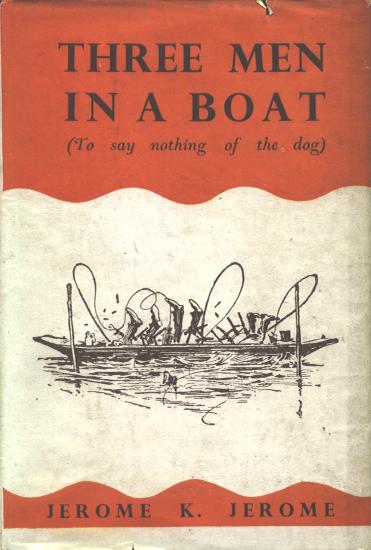

This is a book about three men. They decide to go camping along the Thames by rowing a boat up it. They bring their dog. At some point they eat beef pie and at another they give up on camping and rent rooms at an inn. Harris cannot sing a comic song.

If Seinfeld was the original TV comedy about absolutely nothing, it was still drawing from a legacy that included British humorists like Jerome K. Jerome. This is not a book to turn to if you're looking for deep, character driven, soul wrenching narrative. But it's sly and it's witty and, most importantly, it's enjoyable.

I was introduced to Three Men in a Boat by one of my roommates. She was sitting on her bed reading, and laughing out loud. She shared a quick passage aloud and then went back to giggling. It seemed to me to have been ages since I saw someone react to a book that way. I had to read it and it soon became the first book I finished in a year and a half.

WHAT MADE IT SO PERFECT

When I look back on that time, one quality united the books people recommended to me that I couldn't bring myself to read: Every last one of them was depressing. These books came with endorsements like, "The Time Traveler's Wife is so good! It absolutely DESTROYED me!"

Sometimes we want to be destroyed by a book. Sometimes we need to be. Heavy, topic-driven, important books are... well, important. But in the haste we have to read in order to become better people, sometimes I think we forget the need to read because we enjoy doing it. What about reading because we're in need of a good laugh? Laughter is, in my mind, one of the major hallmarks of escapism. It drives both children's fantasy films and those cat videos on youtube. Laughter is also profoundly comforting, which is why it's often used to sugar-coat difficult truths. And yet a work of fiction that endorses laughter above all else is generally treated as less than something that doesn't.

Art criticism in our culture is overwhelmingly in favor of tragedy. Comedies don't win the Oscars. Hamlet, Romeo and Juliet and Macbeth are treated with more reverence than Twelfth Night or Midsummer Night's Dream. Who wants to give accolades to a play that admits it is Much Ado About Nothing?

Books can be trickier to define as comedy or tragedy. By virtue of being longer, they often contain both humor and drama. Still, there's clearly a difference between Confessions of a Shopaholic and Bleak House. (Hint: One has the word "Bleak" in the title!)

I don't pretend to know how comedy and drama stack up against each other as competing forms of "art." Personally, I think TV land might be the one place where the two genres are handled properly. The Emmy's make a point of awarding both types of shows separately, as do the Golden Globes. But the moment someone hands out an award for "best" movie or "best" book, you can bet that tragedy is going to take a flying leap to the head of the pack. And it's such a shame because frankly, good comedy is very hard to write. We'll watch soldiers die on a battlefield over and over again, but we don't like hearing the same jokes twice. There's intense pressure to be innovative in comedy, often more so than in drama.

Now truthfully, I agree that there is a LOT of not-funny comedy out there, which is why books and films that actually make me laugh are such a treasure. Laughter stirs my soul in a way that is totally different from drama, and often far more poignant. For me to really like a drama, it tends to need a good sense of humor. It's no coincidence that my favorite musical, Into the Woods, builds towards its emotional climax with some of the funniest songs Stephen Sondheim ever wrote.

And even though it often claims to be about nothing, good comedy requires a keen understanding of human nature. Three Men is in turn both very realistic and very escapist. Jerome perfectly captures what it's like to do the most mundane of things, like set up a tent, or bump into lovers at a party. His comedy is shrewd and barbed. The book doesn't exactly have a message, but it has anecdotes that make you reflect on the ego and hypocrisy of ordinary people. This might not seem like much, but it means a great deal to me.

Most importantly, I want to point out that I am not alone. There are lots of people who want to laugh more than anything else. And like me, they are probably shorter than you. This link (link!!!) leads to a study conducted by Scholastic into what children want most from books. While it does change somewhat over time, across all age groups, kids are looking first and foremost for "books that make them laugh." Yes, whether your child is 6 or 16, they want a funny book.

Also of note: Parents do not rate the ability of a book to make their child laugh as highly. The stat is not rock bottom low, but it doesn't reflect the interest kids have in laughing. To add to that, 73% of boys and girls state they would read more if they could find more books they liked. I take that to mean that kids would read more if they could find more funny books. Wouldn't it be great if we made it easier for them to find some? If maybe we handed out Newberry Awards to silly books, and not just issue drive ones? I'm not saying we ditch the issue books, but reading as a whole might benefit if we made it more fun.

Three Men in a Boat helped me get over a tremendous mental block in my life, and it did it mostly by being hilarious. When I finished, I felt intense relief that I was reading again. And with that, I reached for more.

Maybe you have someone in your life who you is looking for a good book. Maybe it's your child, and you desperately want to encourage them to read, but it just doesn't seem to take. Well, if it's true in showbiz, it's true in print. Make 'em laugh. You might just find them coming back for more.


Wednesday, November 11, 2015

The Unsettling: When Books Become Bothersome (Part One)

Sweet cover too, I might add
Towards the end of one of my university classes, we read Sherman Alexie's The Absolutely True Diary of a Part-Time Indian. The book is something of a classic within the Young Adult literary canon, in as much as the discipline has one. YA is still very young as a distinct category, but if there are "foundation" works, Alexie's is surely one of them. The book is semi-autobiographical and deals with issues of race and poverty in the life of a young boy growing up in the Pacific Northwest on the Spokane Indian Reservation.

I knew from the moment I finished the book that I'd read something powerful and wonderful, but when I got to class, I still couldn't shake the feeling of being deeply rattled by it. I piped into the discussion a few times, but the bulk of my thoughts about the book waited until after class when I was talking to one of my friends.  I asked her one thing in particular that was really bothering me.

"Where's the closest reserve to Pittsburgh?"

She paused and thought for a moment. "You know, I'm not sure," she said at last. "I think probably upstate New York. There aren't any nearby."

At that point it clicked as to why, though I enjoyed the book, it hurt in a more personal way than it seemed to strike my East Coast classmates. I knew where Spokane was. I could point to it on a map. And further to that, I had friends and family who had lived through situations similar to the ones portrayed by the book. Of course I had other friends of First Nations decent who lead very different lives, but those who had experienced similar trials to Alexie's autobiographical main character weighed on my mind that night. It had been, for a moment, too close for comfort.

It wasn't until after talking through the book with my friend that I really came to an opinion on it. I love the book now. It's both profoundly tragic and hopeful. It's funny and serious. It's also deeply unsettling.

I don't think that was an accident. Alexie's story was not only something intensely personal, but also one that a lot of people in North America have the luxury of ignoring. There are very few reserves in the Eastern United States compared to the West, and so - tragically, but understandably - First Nations issues are rarely top of mind for a lot of city slickers (and believe me, I can be guilty of this too).

I certainly don't think I had the market cornered on being unsettled by the book. A number of my classmates were. They expressed how glad they were that the book existed, because even though the story took place in America, it was so beyond their experience.  Perhaps the best thing about it is that it's a book that prompts questions, which I think is exactly what Alexie wanted. It's the kind of book that demands to be talked about. I'm not sure you could read it and then go "aw, ain't that nice?" and move on to make a cup of tea.

There are often two competing horses trying to pull your chariot in art. One is trying to point out what's wrong with the world and the other just wants to have fun. I've seen them characterized as escapism versus realism, but that has never seemed right to me. Cat videos on youtube are highly escapist, but their humor completely depends on their realism. (SEE? Cats really ARE that dumb!) To me, the real dichotomy is whether or not a book is escapism or... unsettlism. (Can that be a thing now? I want to coin a phrase. Let's make that a thing.)

Art can either comfort and entertain you or prod you to DO something. Maybe think or empathize or vote or something! Just something! An unsettling book is one that does not want you to "relax" but to wake up. An escapist one wants to entertain you and make you happy. It doesn't care what you do next. Granted, most art tries to achieve a mixture of both. Something that offers no call to action can seem trifling and unimportant while something that gives us no entertaining escape can become so unpleasant, we want nothing more than to toss it across the room.

Alexie accomplishes a fair degree of balance in his novel. The story falls more on the "unsettling" side of the spectrum, but it's offset by a bunch of funny pictures and a humorous narrative voice. He offers the reader that "spoonful of sugar" to go with the medicine.

Still, I've been thinking lately about a pair of other books that did not walk the line so neatly as the The Absolutely True Diary of a Part-Time Indian did. (I mean, just look at the title. It screams non-committal!) They're both older books, and they both firmly planted their feet on either side of the dichotomy.

They are:

Three Men in a Boat (To Say Nothing of the Dog) by Jerome K. Jerome
Tess of the D'Urbervilles by Thomas Hardy

One of these books I love. One of these books I hate. But I'm (grudgingly) starting to admit to myself that both have been incredibly important in my development as both a reader and a writer.

So the next post I put out is going to deal with Jerome and his rampant silliness. Following that, I'll tackle Hardy and the depress-fest that is Tess. Maybe by the time I talk this one through, my opinion of it will improve.

So stay tuned, readers! And in case you were waiting for the final word, yes! Consider The Absolutely True Diary of a Part-Time Indian heartily recommended.

Tuesday, September 1, 2015

A Whiff of a Revelation

Fact: I have a terrible sense of smell.

I have to physically SEE a cat poop in a littler box in order to know that the box needs cleaning. I pull fresh laundry out of the dryer and think "mmm! This is warm!" because my hands are fine at picking up on sensory detail but heaven help my nose. What does our family laundry detergent smell like? No clue! How is my shampoo scented? Ha!

Probable cause of photo: The cameraman farted. Maybe. How would I know?


Maybe it has something to do with a childhood history of nosebleeds. Maybe I spent too much time swimming in chlorinated swimming pools as a tot. I don't know. But something seems to be deeply, permanently wrong with my sniffer.

Or IS there??????

Of late, I am starting to think that the problem is not so much my nose, but my brain. It seems that my nose is actually quite capable but my brain has decided that smell is the proverbial red-headed step-child of the "sense" children. It ignores it at all cost, much happier to lavish attention on other senses, like hearing and touch. (Or, to be frank, to ignore all five and instead devote itself to abstract thought. My brain is a crappy parent in this metaphor.) It will drum up a sensation of smell for me occasionally, like when I'm eating something and my sense of taste is begging for some scent cues to work with, but perhaps this lack of a sense of smell explains why I'm not a picky eater. I like almost everything (what's not to like if you can't smell what's wrong with it?). Or it could be why with the few foods I don't like (mushrooms and overcooked pastry), the issue tends to be one based on texture rather than flavor.

There is plenty of evidence to suggest that the brain has, among its capacities, the ability to rule out various stimuli as "irrelevant" in favor of others that it wants to focus on. It's the reason why we generally don't walk around, constantly aware of the fact that we're wearing clothes. Touch of that particular sort has already faded to background programming. With hearing, there's a phenomenon known as the "cocktail party effect" that the brain uses when we're in a crowd. Generally, we won't hear a conversation that's going on halfway across the room, or at least we don't think we hear it. Magically, our ears perk up the second someone says our name or something that interests us, even if they're far away, and then off we go to find out what they were saying about The Hunger Games.

Fact: If you are talking about The Hunger Games at a party, I will hear you.

So on the whole, my brain seems to have decided that my nose is hopelessly irrelevant. How do I know this? Well, because I am in the late stages of a cold right now and the world has never smelled more vibrant.

When this cold commenced, I experienced no loss of (perceived) ability. Maybe once or twice, when I was much MORE cognizant of the fact that I was drowning in a deluge of my own mucus (look, if you're grossed out, this is your own fault for reading this. You knew by now this post was about the sense of smell), the thought would also strike me, "wow. I can smell NOTHING." But these were fleeting moments.

Now, I am almost well. Frequently, my nose is clear, and you know what? THERE IS A WHOLE WORLD OF SMELLS OUT THERE!!!! The cat is pungent! The rain is laced with mowed hay and ripe blackberries! The breeze is salty and oceanic! Hours after dinner, the house still smelled like stew! And... good heavens, the cat litter really does need changing.

Guys, the world is magical.

My brain had been deprived of the background information it would usually ignore. But apparently, it's got serious FOMO, because once I got a hint of my sense of smell back, it came screaming out the gates all "whadImiss? WhadImiss???? TELL ME TELL ME TELL ME!!!!"

A week from now, I will doubtless be back to full health. And with it, my brain's elitism will oust olfaction from its list of primary concerns. But until then, everything's coming up roses for Emily.


Okay, so ... this had nothing to do with books.

Whatever, I'm out.

Monday, August 17, 2015

Grammar sins: To care or not to care?

Years ago, when American Idol was relevant, several friends of mine asked me if I liked the show. Particularly, they wanted to know if I liked the auditions.

Except by "asked" and "wanted to know," I mean that their inquiries were more confident than either of those phrases would imply. It usually went a like this:

"I bet you love the auditions!"
"Oh, I just know you've gotta love laughing at those poor losers who can't sing!"
"Aren't Simon's criticisms hilarious?"

And the answer to all of those questions was no, no and NO again. The auditions for American Idol made me feel incredibly uncomfortable, but people assumed I enjoyed them. Why? Well, because I sing. I was among the stronger singers in my peer group and there was this unspoken assumption that because of that, I must identify with those who were successful in the auditions and see myself as superior to those who weren't. But this assumption was incredibly far off.

While there were always a few downright awful contestants, a lot of the people getting belittled on the show were simply people who weren't good enough. Under the lens of national television, their deficiencies were amplified. Some of these people (I am guessing) probably could sing okay when they followed along with an accompaniment. Or when they had a friend nearby to help them stay on key.

Or maybe they were singing the wrong genre. Singing is not as much of an "all around" skill as it might seem and some people struggle to find their niche. In my case, my voice and training lend themselves to show tunes. I can assure you that if I ever had auditioned for American Idol (or the Canadian version) I would have been turned away and called either uninteresting or pitchy. I suck at Pop music.

But even if it wasn't the case that I, personally, would not benefit from the praise of the gatekeepers of reality TV, it bugged me on a more fundamental level that society was getting its jollies laughing at people brave enough to fail on the national stage. We live in a culture that loves shaming people for not being good at things, crossing our fingers that there will be an extra measure of pride showcased before they fall. I get why that narrative is appealing. I get why we love to see braggarts put in their place and I am certainly not above delighting in the misfortunes of those that "deserve" them.

But I also think it's extremely dangerous to do this if we want to encourage a boldly creative population. Every time we laughed at an unsuccessful audition we were, in some sense, reassuring ourselves for not taking the same risk. Thank heaven we didn't try! The world could have been laughing at us.

Today, I don't believe myself alone in feeling this way about American Idol. That particular style of shaming has fallen out of vogue. But you want to know what is alive and well? The Grammar Police. And I feel about 95% the same way about them.

As in the American Idol situation, people love to assume I have a vested interest in grammar. And I do. Sort of. I need to know how to use it properly for my job (writing) and by understanding it well, I learn how to effectively subvert the rules.

But I do not give two figs about how you say the word "supposedly." I couldn't care less if you could care less. I have no opinion on the Oxford Comma. And lamentably, if you are among my Grammar Police friends (and I have many of you), I will not be your comrade in snarking about these offenses.

I admit, some of my bile for the Grammar Police is irrational. More often than not, they're an inoffensive bunch. They're that kid who got you to say the word "underwear" just by asking you, "hey, what's under there?" (Additional true statement: The Grammar Police spend their time off the beat in donut shops, speaking in nothing but well-timed puns) But I do worry that the Grammar Police are handing out more tickets than necessary. If we want people's use of the English language to improve, often we need LESS policing. Not more. Or at least... better policing.

Here's the deal: In my view, improper grammar is a lot like sketching in pencil before reaching for a paint brush or pen. You want the lines down there to guide you, but you don't necessarily need them in the exact place. Agonizing over exact line placement in the sketching stage could potentially kill your ability to communicate movement in the figure. It's only when you're putting on permanent details that the lines need to be right.

The same goes for speech and writing. Most things we say casually are not permanent. Speech is an ideal time to experiment with language and listen to your own words. Agonizing over grammar might impede your ability to communicate and might kill the flow of your natural voice. The trick, however, is to be self-aware. If you want to change the way you speak - improve at public speaking,  or learn how to make a room laugh - then you will need to be able to reflect on the results you get from what you say. And that immediate feedback will be the rules and grammar that you personally need to follow.

Even more important, if you are someone seriously considering improving your writing, you need to throw your Grammar Police hat out the window. You will not type fast enough with it on. You will not think fast enough with it on. Drafting is ALL about experimentation. It's about making errors and daring to be bad at something, all in the hopes of getting good at it eventually.

One of the most consistent pieces of writing advice I've received concerns this sketchy, drafting phase. When drafting, forward motion is WAY more important than getting it "right." You will have to edit. Extensively. I promise. But your edits will be less meaningful if you do not have the story on the page. Assuming for the moment you're writing fiction, what if you discover that the scene you're working on needs to be cut from the story? All the fussy editing you did to that scene will vanish. Save that energy for when you've got a basic product to work with. Spotless grammar is only useful to you in a finished product, when the work of substance has long been completed.

And while this might sound extreme, I stand by my belief that using language incorrectly is an essential part of developing a creative sensitivity towards it. Most of the writers I know are NOT grammar police. They're willing to play fast and loose with language. They're the people who do things like this:

Writer: I literally died when Joey came in the room!
Friend: Holy crap, did you really just say that? You are still alive so you don't actually mean "literally."
Writer:............ No, I do mean literally. I died. I went to heaven. They have orange soda there. Then someone gave me CPR and I came back to life. IN THE ROOM. I cam back to life in the room and Joey was STILL THERE!!! AND SINCE HE WAS THERE I LITERALLY DIED AGAIN!!!!! LITERALLY LITERALLY LITERALLY!!!!

(Additional true statement: Writers are obnoxious twerps)

And in a backwards sort of way, this is where the Grammar Police do have their value. Let them correct you. Let them teach you. Then try to think through how they could be wrong. Because you're not actually understanding grammar unless you're able to envision a way in which that person, with all their rules and check boxes, could be flat out, deliciously wrong. So fight back and get creative.

I want to reiterate that I DO see the value in clear, crisp, beautiful grammar in a finished product. I re-edit my blog entries periodically for no reason other than that I want them to look nice. I want them to be precise. When it comes to precise meaning, nothing can beat well used grammar.

If you're getting a tattoo, get your grammar straight. If your grammar is so bad, it legitimately impedes your ability to communicate, then yes, improve your grammar. If you're writing a paper for class, you need an exceptionally good reason for ignoring ANY rule of grammar, which means you will need to know the rules. Don't stress out about your text messages. Come up with your own policy on Facebook posts. Accept that everyone sounds like an idiot occasionally on Twitter. But don't let anyone stop you from communicating or using words that confuse you. Use them. Use them wrong. Replay them in your head. Figure them out. We live in a world where people recognize more words than they ever dare speak. Don't be among the silent. Stick those "word-a-day-calendar" words into your conversations and shrug your shoulders when they don't come out right. Write the word you want to use even if you can't spell it. You will learn. I promise.

One more important thing about grammar: To love grammar is to love a changeable thing, but most people who love grammar do NOT love it's changeability. And this rigidity sometimes does nothing more than stifle the natural progression of language. Take, for instance, the word "they" - a legitimate, gender neutral way of indicating a single individual in a sentence. The need for him/her is behind us. I've checked and re-checked this one because people keep trying to "ding" me on it. Style guides might still tell you to avoid it, but not because it is incorrect. Instead, you're counseled to avoid it because people THINK it is incorrect. And heaven forbid this happen to you:

You: I love the present my Secret Santa gave me! I'm going to give them a hug when I find out their identity.
Grammar Police Co-Worker: You mean you'll hug HIM/HER when you find out HIS/HER identity!!!!
You:......................................... seriously?

I'll admit, this entry has been ranty. If you are a proud member of the Grammar Police, know that I am more than happy to "agree to disagree." You are among those who bring a great skill set and depth of knowledge to discussions around language. Value and love your grammar. But if possible, could we maybe make the discussion about teaching rather than shaming? There are a lot of bright, clever people out there who don't feel that way because they haven't figured out the rules you play by.

This is my feeling: We need more people grappling with semi-colons. We need more people who sing in public. We need more people who mess up dance steps. We need less shame. We need more failure. It's the only way to open the door to success.

Monday, June 29, 2015

Writerly News: On Eggs and Waiting out the Waiting Game

I am right now suffering from one of the most prevalent disorders known to writer-kind. Symptoms include: 
  • Delusions of grandeur routinely followed by crippling self-doubt
  • Refreshing of the email inbox at an obsessive rate
  • Stalking of literary agents on twitter
  • Phoning your mother at absurd times and saying nothing is going on. You just "want to talk"
  • Hoping your mother doesn't catch on to you 
  • Banging your head against the computer as you try to force yourself to write something - really anything - that isn't that last story you fell so head-over-heels in love with
If any of these symptoms are familiar to you, then CONGRATULATIONS!!! You might be querying your novel!!!!

I've talked a little bit about querying before and honestly, probably the hardest thing about it isn't the actual work of querying or even the inevitable and frequent rejection. It's the waiting. Waiting gives me opportunity to play head games with myself and frankly, I don't need any extra time or motivation to do that. 

For example, a few days ago, I asked my sister if she wanted me to make scrambled eggs. When she said she didn't, I did my best to act like I understood, but ultimately we needed to sit down and chat about why it was I'd wanted so badly to make her eggs and why she didn't realize that saying, "No, it's okay. We'll just feed the boys mac n cheese" was so disappointing. Eventually, she let me make her a grilled cheese sandwich and I felt better.

Let me repeat: THIS WAS OVER EGGS!!!! 

Like, this was over something that really didn't matter, and I still had dreamed up this whole narrative in my head of why the eggs should be scrambled, what would happen when they were and why the universe would be a better place because I had scrambled some eggs. So when it didn't happen, the whole world order came crashing down and had to be reconsidered because, apparently, the world was fine without my eggs.

If it's distressing when the world is fine without my eggs, you can only imagine what sort of mental and emotional acrobatics I put myself through wondering whether or not the world needs my books. Intellectually, I know that it probably doesn't need my particular voice any more than it needs any other honest, sincere person to speak up/write something down. I do believe that we're all created equal and that everyone has a story inside them and a voice worth listening to. The difference between writers and everyone else is frequently no more than mode of expression. But all the same, I wrote my book because I needed to share my stories. And hopefully, someone in the publishing world will find them more beguiling than my eggs.

In the meantime, one of my hardest jobs is to keep writing - to focus on future manuscripts rather than the one I've been sending off to literary agents in hopes of attracting attention. This is a skill I'm still learning. But this blog has become something that really helps me keep my mind on something else. And for that, I am super-duper grateful.

So to all of you who read this, thank you. Being able to talk with you about books has become one of my favorite ways to reboot my brain when it's agonizing over querying, writing and eggs.

Monday, June 15, 2015

The Lonely Artist, Support Groups, and Productivity - Lauching the Famenous Arters

Most people who have known me for about half an hour know that I love to talk. And not just talk, but talk about things. I can form opinions within minutes on almost any topic. I excelled at speech contest in high school, frequently reaching finalists rounds and winning one year. The two most frequent compliments I get are "you sing well" and "wow, you're really articulate!"

In other words, I am super good at making noise.

Perhaps most striking (or damning, depending on your perspective) was this feedback I received from a beloved professor after a class presentation I gave in my final year of my undergraduate degree:

"You clearly really understood your topic, or at least knew how to sound like you do, which is often just as important."

Yes, my friends. There is mounting evidence that I sound smarter than I actually am.

The result of this is that most people are either shocked or think I'm delusional when I tell them I'm a rather solitary person. But it's true now and it's been true my whole life. If you ask someone who has known me longer than a half-hour - like someone I've lived with - they'll vouch for me. I spend an exorbitant amount of time at home, on a computer, typing. The explanation for why these two versions of me can coexist is really very simple. If I don't feel like talking, I don't go out in public. So if you are not currently listening to me talk RIGHT AT THIS VERY MINUTE, I am probably being quiet somewhere.

The truth is, solitary introspection is a prerequisite for any writer. When it comes to the work of actually writing, that involves sitting down, putting words on a page, and ignoring all outside stimuli that could distract you. This, of course, is true of several careers, but I think in writing, it matters even more. The act of writing is translating what goes on in your head into text. You must like being alone, contemplating your own thoughts if you want to get your head to produce the strongest possible product. There's something of a romanticism to the lone author, sitting at a typewriter all night, living off of nothing but cigarettes and coffee. Books are somewhat unique in that, by and large, they are the work of one person. One mind slogging it out in a dark, lonely corner.

But are they?

The truth is, almost universally, books come into this world with the help of many people. There are agents and editors and publishers, who help sculpt the raw text into something more polished. But even before those people, most authors rely on other sources of feedback in the form of writing groups and critique partners. It's at those moments that the Lone Wolf Writer has to step up and share their sloppy, cobbled-together pages with their first round of critics, in hopes of somehow making the manuscript better.

When I think of the things I learned during my Master's degree, by far the biggest lesson was the value of critique. Comments my peers made inspired parts of my manuscripts I might have never found otherwise. Classes were a call-to-action unlike anything I'd had before. Not only was I being forced to write better, but I was being pushed to write more. That opportunity to work and grow as a class was so valuable, I had to produce as many pages as possible in order to get the value I wanted from that experience.

Most importantly too, it took the loneliness out of writing. I'd never had so many people reading and responding to my work and there was an incredible sense of power that came from the idea that maybe my work wasn't just about me, but was about them and every other future reader I hoped to have.

All art has the potential to be lonely. It requires practice, patience and a kind of single-mindedness that makes you seem a little weird, further limiting your social circle. If you meet someone who excels at anything artistic, whether music or painting or dance, I think you'll find someone who has given up a lot of their life. So it's little surprise that few things give us power like getting help along the journey from another artist.

Since finishing my degree, that's what I've missed the most. Since Christmas, I've been living in Ottawa, working a regular job and fitting my creative work around it. I've managed to get a lot done and have some great successes, but I've also been very alone. I don't know any writers out here. I never managed to find friends that I could sit around drawing with either. The art has been solitary, and it's been harder because of it. But next month, I think I have a chance to change that.

In July, I'm moving back to the west coast, my forever and always home. It's not quite the nest of artistic support one might think, though. I didn't go to school there. Most of the writers I'm acquainted with are tucked in around Pittsburgh, Pennsylvania.

But it has one, named Miranda, who happens to be one of my best friends. (You can read her blog here)

And it has a couple of artists, who dabble in comics.

And someone who plays classical recorder.

And a dancer/make-up artist who knows mysteries about taking a good selfie I'll never understand.

Our only problem is we're unorganized. Oh, sure, we've gotten together a few times before to sketch and talk about Disney movies. But I think we could do more for each other. I want us to. So with Miranda's help, I'm launching my own "all arts invited" artistic support group, the Famenous Arters.

Clearly painting with friends always
helps me create my greatest work.
Why Famenous Arters? Because even though none of us drink, someone managed to babble out that phrase during one of our drawing binges. (I think it was me. I said I liked to talk. Sometimes I don't know my limits.) And it speaks to our goals: To make art. To be famenous.

Famenous Arters launch day will be in July. Our goal is to hold an art related activity at least twice a month. At it, we'll report on what we've done and share new work if we're so inclined. Then we'll hang out and be awesome and have snacks and play games and make art and oh my gosh, guys, it's too much!!!!

At the end of summer, we'll see where we're at. We might even hold an exhibition.

I'm pretty excited about this. I want to force myself to grow as an artist, but I don't want to do it alone. And I want to see all the wonderful, talented people I know have somewhere they can go for support and motivation to stretch their craft, whatever it may be, a little further.

Saturday, May 23, 2015

How "real" is fiction? Or: Why you don't want me to base a character on you

A few weeks ago I spent an evening at the mall. I didn't have much to do there and so, like a lot of bored people at the mall, I people-watched. Since I write primarily for children and young adults, it goes without saying that those two groups tend to entertain me the most. This was thrown in particularly sharp focus when one teenager approached me and asked, "Excuse me Ma'am, do you know what the time is?"

I am not yet in my thirties. By most accounts, I have a long way to go before I truly reach "Ma'am" status, but nonetheless, this really entertained me. It drilled home how differently we see people at sixteen versus ten years later. I posted this online, along with some tongue-in-cheek observations about "teen" fashion, and received some entertaining feedback from friends and family.

One of the people who commented was a close family friend,  one of my mother's very best friends. She jokingly said that if I ever wanted to write a character who showcased the sensible attire of adulthood, I could base that person on her. The question hit perilously close to home because, you see, I don't really base characters on people that I know. It really is true that for those of us who write fiction, the vast majority of what we write about is flat out "made-up." If we were really interested in faithfully reproducing reality, we would write non-fiction.

But of course....

There are exceptions.

But what are they? How does real life influence fiction and how, in particular, do the people we know end up in the books that we write? I'll be speaking primarily for myself here, but given the conversations I've had with a lot of fiction authors, I think these are some common trends. Certainly some authors write their own lives, thinly veiled as fiction, but most of us don't.

Izzy, Sandra, DeeAnne and Chireen, a few of my "realest" characters
One of the main reasons I think people ask if I've ever based a character on them or someone else we know, is because, instinctively, we know almost all art comes from a place of lived reality. The easiest setting for me to write about is the west coast of Canada. I spend less time second guessing myself when I write from a female perspective than when I write from a male one. I have a deep knowledge of the myriad ways someone can point out to another person that they are short.

But at the same time, I don't want my stories to be populated by no one but short, Canadian women. I don't want my characters to all be white, either. Or cat lovers. Or artsy-fartsy. So where do we turn for inspiration when we want a more diverse cast?

If your answer was "real life" then yes! You are right! But on the whole, writers don't zero in on specific people and decide to rewrite them. Most of what I've learned from my friends, families, coworkers, acquaintances, and random people on the street gets taken in, digested and regurgitated in a less than familiar format. Most of the time, I'm not even aware of any similarities between the characters I've written with the people in my life. On occasion, though, I will look at someone more critically and go, "wow. That reminds me of so-and-so."

The most common place this occurs is with the families I write. When I started my current project, Rift Runners (see the Current Projects tab above if you're curious) I had been living away from my older sister for several years, missed her terribly, but was also rather excited that we now both lived in cities out East, so that meant we'd probably get to see each other at Thanksgiving. This spilled over into the central relationship of the story, which revolves around a pair of sisters, told from the younger one's perspective, though I didn't see the parallels until I was well into the story.

Of all the people who have wormed their way into my manuscripts, probably no one has turned up more than my mother. Little pieces of our relationship are sewn everywhere. Every fierce, protective, loving character I've ever written hearkens back to my Mum. But it isn't all rosy, either. The great thing about parents is that no matter how much you love them and how well you get along, you are guaranteed to have fought with them at some point. And since conflict is absolutely necessary for plot, it's pretty fair to say that my arguments with her turn up. But the stakes change. Instead of the topic being unfinished homework, it becomes a life and death scenario - something I don't think my mum and I would actually argue about. But that's the thing about basing something on real life. Only aspects of real life experience might be useful and, odds are, I'm going to have to push it to a further extreme in order to get something that works for the stories I'm writing.

In fact, if I can think of a reason that people should hope they are NOT in my stories is because of that point I made earlier. Fiction requires drama and conflict. The majority of the characters will not be the protagonist. All the other characters exist to bring either drama or conflict to the plot. So if you were a character in my novel, you would need to be ready to be misunderstood, have your worse qualities showcased or, if you do happen to be a lovely, nice person, you'd end up fulfilling your obligation to cause conflict by getting sick or blowing up or something (I write a lot of sci-fi and fantasy. People blow up. It's true.). Obviously these are not hard and fast rules, and all characters need to be well-rounded, but it's not a pleasant scenario. It's for these reasons that I don't actively look for real life counterparts for my characters. I don't want to make my friends look bad and I don't want to blow them up. I like them too much.

Also, I desperately want to avoid what I imagine would be this conversation:

"Yes, this character is based on you, but NO! Of course I don't think of you like that! No, don't worry. It's just made up.... seriously, don't worry. That's not what I meant by based on you. I meant, like... I took your hair, your birth date and your strained relationship with your aunt and wrote a book about it."

But there are exceptions. In a few instances, I have used real people as a jumping off point for characters I've written. I'll list a few examples below:

1) Nolan Ciora - a plucky, trade caravan leader struggling to hide that he's half-elf in a very pro-human world.
Based on: I spent a summer working in a garden center where I had a coworker whose name was Nolan. I made up "fake" Nolan within a couple days of meeting the real one, largely because I loved the impression I got of my new coworker and didn't want to know him well before writing out my own interpretation. Fake Nolan was never meant to be a faithful retelling of Real Nolan. Instead, all I know for certain is that they share some similar surface details - name, aspects of appearance, general pluckiness. Any of Fake Nolan's inner motives and daemons are entirely made up, because Real Nolan and I only knew each other for a few months and never worked in the same department. It was a pleasant acquaintanceship and no more. I don't even know Real Nolan's last name.

2) Izzy, Sandra, DeeAnne and Chireen - I once wrote a play largely based on my experience of being a young, single lady and a member of the Church of Jesus Christ of Latter-Day Saints. These girls were the protagonists.
Based on: Because it was a play and I have a lot of friends who love theater, the four main characters were designed not so much to resemble my friends in personality, but to resemble the types of characters I could see them doing a good job of playing. But there were a couple of inside jokes thrown in for good measure. DeeAnne is a girl waiting for her boyfriend to come home from his mission and when I started writing the play, one of my friends had a boy on a mission as well. Their personalities, however, are VERY different. Of course, there were aspects of the various Mormons I know sewn into the whole play, but I don't think any of the characters were a retread of people I knew on any deep level.

3) Kenton Adler - A minor character. The younger brother of one of my protagonists.
Based on: While I was living in Pittsburgh, a friend of mine invited me and some other people over to watch some movies. I arrived late, but underestimated just how late everyone else would be. The host wasn't even home when I got there. I rang the doorbell and my friend's roommate - whom I had never met before - barreled down the stairs to open the door... wearing nothing but a towel. He'd been in the shower, knew his roommate was expecting people and profusely apologized for greeting me nearly nude. I wish I could say there was a deeper story beyond that - that we went on to star in a screwball romantic comedy or something. Life doesn't give you a lot of moments like that. But in truth, we never met again after that awkward encounter that night. But it was so funny and so entertaining to me, that I thought I would honor it by naming a minor character after him. Once again, I don't know Real Kenton's last name. Regrettably, it would not be appropriate for Fake Kenton to show up half naked in a story, as Fake Kenton is a thirteen-year old boy and guys, that would be gross.

So as you can see, most of these stories involve people who I either don't know well or I was only grabbing aspects of them. I honestly can only think of one time, where I took a look at my plot and what it needed and said to myself, "you know, what this story needs is a person like..."

4) Patience Lyle - The leader of the Rift Runners, an undercover, anti-government, morally ambiguous group of revolutionaries.
Based on: You might remember I started this post by telling a story about watching teenagers at the mall, and this prompting a joke from one of my mother`s longtime friends. A joke about me basing a character on her. Someone sensible and comfortable with her own age. From anyone else, I would have laughed or shrugged and been done with it. But as luck would have it, this woman was the one and only person I can point to from whom I consciously crafted a character.

Creating Patience was an odd experience for this reason. I certainly took liberties with the character`s personality and, again, didn't try to hem close to anything that actually had happened. But whenever I needed further insight for writing Patience, I thought back to the woman who inspired her. More than anything, there was a certain "feel" to the character I wanted to recapture. Patience is an intense person, with a level of power to her persona that leaves you constantly playing catch-up. And this was just how my Mum's close friend made me feel, especially when I was a teen. She was smart. She spoke French. She taught high-school, which to me seemed to be one of the most terrifying occupations in existence.

She still is all those things, incidentally. But when I was younger and still trying to make sense of how adults fit into this world as people - as fully fledged, flawed human beings - she was one of the few adults beyond my parents I had the freedom to really examine and think about. She didn't engage me as a simple kid, the way some of my friend's parents did, but as a reasonable, near-adult. I think that came from teaching in schools. Kids and teenagers can tell when someone is lying to them or tippy-toeing around the truth, and she never did that. She shot straight. To this day, I love that about her.

And so perhaps it's little wonder she turned up in my writing. In Rift Runners, Patience is one of the first adults the protagonist, a teen-aged girl named Shasta, really has to make sense of outside of her family. A lot is riding on that relationship and, as Patience leads a group of rebels rather than a classroom, the dramatic stakes are considerably higher.

As the years have gone by and I've transitioned from near-adult to actual-adult, the way I relate to my mother's friends has changed. But this woman is one I still feel close to and we now enjoy a camaraderie that grows as the age ratio separating us narrows bit by bit. I've often felt nervous about admitting to her that she's in my work. Patience certainly doesn't escape the pitfalls of being a character who isn't the protagonist. She's misunderstood and misrepresented through Shasta's narrow point of view. Patience's portrayal in Rift Runners is not meant as the be-all-and-end-all version of the character herself. You can only imagine how far that representation is from the person she was based on. I wish I didn't have to give Patience such a raw deal, but the story isn't hers. It's Shasta's.

Regardless, I love Patience. She's one of my favorite characters in the whole story. And since some day I'm sure she'll read one of my books, I might as well fess-up now and say, thank you, Liane Lyle. I can say without reservation that my writing would be less if not for you.